The kerf debate lives on for a reason. On paper, the difference between thin and full kerf may seem minor, but in real use, it can affect how your saw cuts, how much power it needs, and how stable the blade feels during a cut.
Thin or full kerf circular saw blades? Choosing the right one depends on your saw, the material you’re working with, and the type of projects you cut most often. Here, we will cover everything you need to know about thin and full kerf blades so you can make the right choice for your setup.
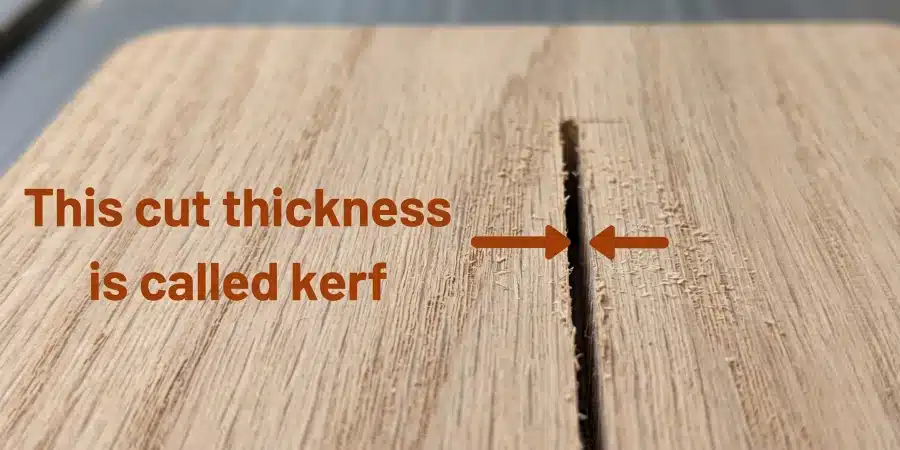
Table of Contents
- What is the Difference Between Thin Kerf and Full Kerf Circular Saw Blades?
- What Are the Advantages of Thin Kerf Circular Saw Blades?
- What Are the Disadvantages of Thin Kerf Circular Saw Blades?
- What Are the Advantages of Full Kerf Circular Saw Blades?
- What Are the Disadvantages of Full Kerf Circular Saw Blades?
- Which Kerf Blade Should You Choose for Your Saw?
- Which Kerf Blade Should You Choose for Your Project?
- Thin vs Full Kerf FAQs
- Conclusion
What is the Difference Between Thin Kerf and Full Kerf Circular Saw Blades?
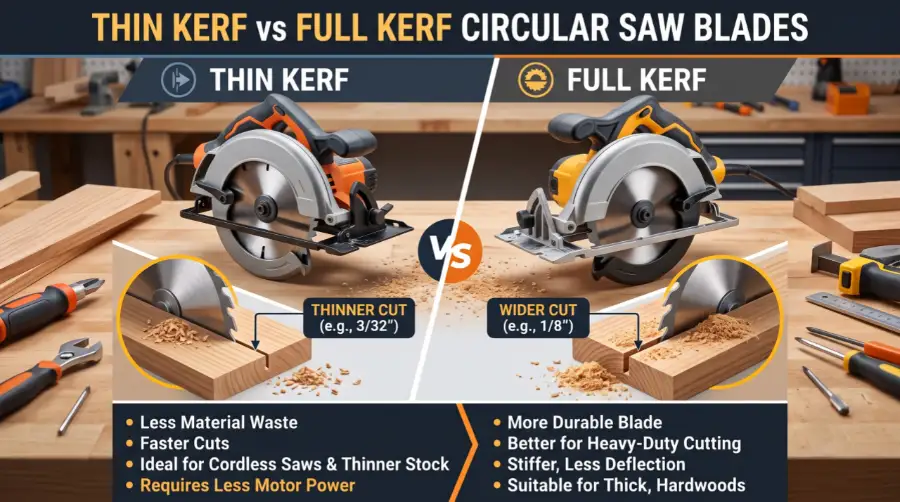
Thin kerf blades slice a thinner path, so your saw wastes less material with every pass. This typically results in less load on the motor and smoother cutting performance, especially on cordless and lower-horsepower saws. Full kerf blades take up a wider path and use a thicker blade body. This added thickness helps the blade remain straighter under load. As a result, many woodworkers prefer full kerf blades for tough jobs and long rip cuts through thick hardwoods. Simply put: thin kerf blades are about efficiency, while full kerf blades are about stability.
What Are the Advantages of Thin Kerf Circular Saw Blades?
Uses Less Motor Energy
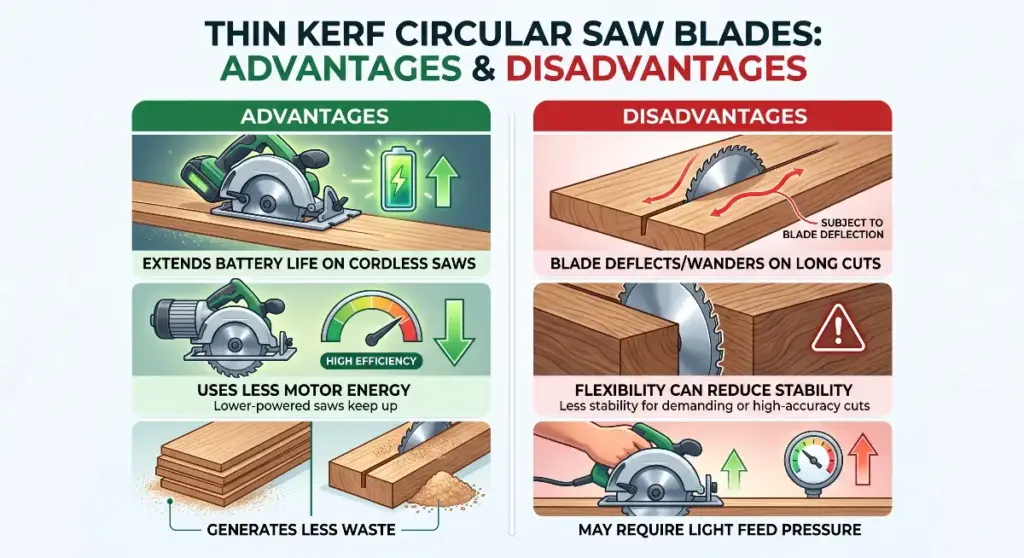
Thin kerf saw blades remove less material with each pass, so your saw’s motor won’t have to work as hard. That means you can make better use of lower-powered saws because they won’t bog down as easily when cutting through dense stock. Some manufacturers even design and market thin kerf blades as low-resistance options to help smaller saws keep up with demanding cuts.
Extends Battery Life on Cordless Saws
Less cutting resistance also means less power is needed. That’s why thin kerf blades are commonly recommended for cordless circular saws and track saws, where maximizing battery runtime is important.
Generates Less Waste
Simple math says a thinner slice creates less sawdust. You probably won’t notice the difference unless you work with expensive hardwoods or are cutting large quantities of material.
Can Cut More Efficiently
Because thin kerf blades remove less material, they create less resistance as they cut. That doesn’t necessarily mean they’ll always cut faster, but they often make cutting feel easier, especially when using portable or lower-powered saws or cutting through thick materials.
What Are the Disadvantages of Thin Kerf Circular Saw Blades?
Subject to Blade Deflection
Thin kerf blades flex more during long rip cuts. When cutting thick hardwoods, variations in feed pressure can cause the blade to wander off the cut line. This is rarely an issue for occasional DIY projects, but it becomes more noticeable when making long cuts through dense hardwoods such as oak or maple.
Flexibility Can Reduce Stability
The more demanding the cut, the more blade stability matters. Long cutting sessions, thick materials, and even production work can put more stress on the blade. If you find yourself in any of these situations, a thin kerf blade may not feel as stable as a full kerf blade, especially when accuracy is your priority.
May Require Light Feed Pressure
Aggressive feed rates can increase the chance of blade deflection. In many cases, a thin kerf blade performs best when you let it do the cutting instead of forcing it through the material. If your project requires a high degree of accuracy, a full kerf blade will usually provide greater stability.
What Are the Advantages of Full Kerf Circular Saw Blades?
Less Flexing
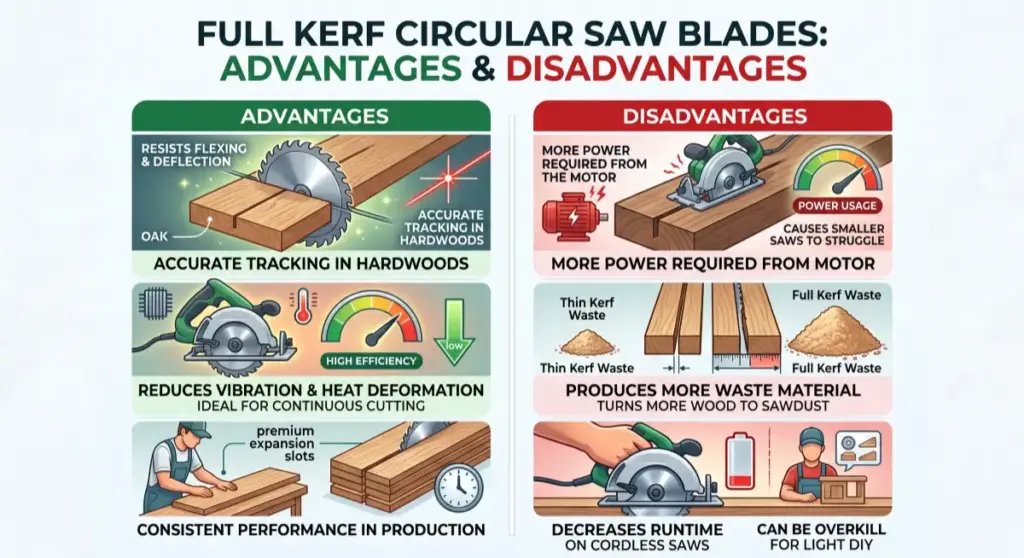
The added thickness in the body of the blade helps it resist flexing when cutting. This can help the blade track more accurately during a cut.
Excellent for Thick Hardwood
Higher-density wood exerts more pressure on a saw blade. If you’ll be doing long rip cuts in hardwoods like oak or maple, a full kerf blade is less likely to bend or flex. It will hold its position better, producing straighter lines from start to finish.
Ideal for Continuous Cutting
Jobsite work is often inconsistent. But in a production environment, you want your cuts to be consistent. And that is what a full kerf blade offers. It can handle repetitive cuts and longer jobs with more consistent cutting performance.
Ideal for Heavy-Duty Saws
Full kerf blades are very rigid. They are less prone to blade deflection, even during long ripping jobs.
Reduces Vibration and Heat Deformation
The thicker blade body can also help reduce vibration during demanding cuts. It is also less likely to deform from heat during extended cutting. Some premium blades even feature laser-cut expansion slots, allowing the blade to vibrate less and run quieter.
What Are the Disadvantages of Full Kerf Circular Saw Blades?
More Power Required from Your Motor
This is just common sense. The more material you remove with each pass, the harder your saw has to work to maintain the cut. Full kerf blades will cause smaller saws to work harder, especially when you’re cutting deeper and thicker stock.
Produces More Waste Material
Full kerf blades turn more of your material into sawdust. The difference in material removed can often be negligible, but it might be something to consider if you’re working with pricey hardwoods or have an extra-large project.
May Decrease Runtime on Cordless Saws
In addition to requiring more power from the motor, the added resistance uses more energy per cut. If you’re using a cordless saw, you may find that you can make fewer cuts on a single charge.
Full Kerf Blades Can Be Overkill
Not every cut requires the rigidity of a full kerf blade. If you only do occasional DIY projects or light-duty woodworking, you might not notice much difference between full and thin kerf blades.
Which Kerf Blade Should You Choose for Your Saw?
Choosing between a thin kerf and full kerf blade starts with the saw you’re using. Lower-powered and cordless saws generally benefit from the lower cutting resistance of thin kerf blades, while larger stationary saws can take advantage of the added stability of full kerf blades. Use the table below as a quick guide when choosing the right kerf blade for your saw.
| Saw Type | Recommended Kerf Blade |
|---|---|
| Cordless Circular Saw | Thin Kerf |
| Cordless Track Saw | Thin Kerf |
| Compact Table Saw | Thin Kerf |
| Jobsite Table Saw | Either (Thin Kerf Preferred) |
| Contractor Saw | Either |
| Hybrid Table Saw | Either |
| Cabinet Saw | Full Kerf |
| Industrial Panel Saw | Full Kerf |
| Multi-Rip Saw | Full Kerf |
As a general rule, choose a thin kerf blade if your saw has limited power or runs on batteries. If you’re using a larger stationary saw and regularly make long rip cuts through hardwood, a full kerf blade is usually the better choice.
Which Kerf Blade Should You Choose for Your Project?
Choosing between a thin kerf and a full kerf blade depends on how demanding the project is in terms of cutting efficiency versus cutting stability.
Thin kerf blades are generally better for DIY, remodeling, and sheet material work where ease of cutting and reduced material waste matter more. Full kerf blades are better suited for furniture making, hardwood milling, and production work where cut stability and accuracy are more important than efficiency.
The table below provides a quick reference by project type.
| Project Type | Recommended Kerf Blade |
|---|---|
| General DIY Projects | Thin Kerf |
| Home Renovation & Remodeling | Thin Kerf |
| Framing & Construction Work | Thin Kerf |
| Sheet Goods (Plywood, MDF, OSB) | Thin Kerf |
| Furniture Building | Thin or Full Kerf (Depends on tools and precision needs) |
| Hardwood Milling | Full Kerf |
| Cabinet Making | Full Kerf |
| Production Woodworking | Full Kerf |
| High-Density Hardwood Projects | Full Kerf |
As a general rule, choose a thin kerf blade if your saw has limited power or runs on batteries. If you’re using a larger stationary saw and making long rip cuts in hardwood, a full kerf blade is usually the better choice.
Thin vs Full Kerf FAQs
If you have a cordless saw, a jobsite saw, or any tool with limited power, a thin kerf blade is usually the better choice. Since less material is being removed with each cut, there’s less resistance and your saw can cut more efficiently.
For the most part, yes. You’ll just need more power to push the blade through the cut, which can reduce battery runtime and put more load on the motor, especially when cutting dense or thick material.
Yes. Many professionals use thin kerf blades with cordless and portable saws to improve cutting efficiency and reduce strain on the tool.
Circular saw blade kerf is not strictly standardized, but most blades fall into two common ranges: about 3/32 inch for thin kerf blades and about 1/8 inch for full kerf blades. The exact measurement varies by blade design and manufacturer.
Yes, as long as the blade matches your saw’s diameter and arbor size. The main difference is how much power and stability each blade requires during cutting.
Conclusion
Let’s set one thing straight: the thin kerf vs full kerf debate doesn’t need a winner. It depends on the application.
Thin kerf blades are all about efficiency. They require less power and produce less waste during cutting. Full kerf blades are all about rigidity, offering more stability and consistency when ripping through tougher materials.
In general, most cordless and portable saw users will benefit from a thin kerf blade, while cabinet shops and production environments are better suited to full kerf blades.
At the end of the day, the best blade is the one that matches your saw, material, and workload.