If you already own a string trimmer collecting dust in the garage, purchasing another piece of outdoor power equipment may seem pointless. This is especially true if you only need to cut thicker grass, weeds, or some light brush. Sometimes the simplest solution is to get more use out of what you already have.
For that reason, installing a brush cutter blade on your string trimmer may seem like a logical choice. If you can make it fit, there is really no reason not to use it, right? Unfortunately, compatibility is not quite that simple. Brush cutters and string trimmers may look alike, but switching cutting attachments is not the same as swapping out machines.
So, can you put a brush cutter blade on your string trimmer? The answer depends on the exact model and the complete blade setup. Here is how to find out before buying a blade or attempting the conversion.
Can You Put a Brush Cutter Blade on a String Trimmer?
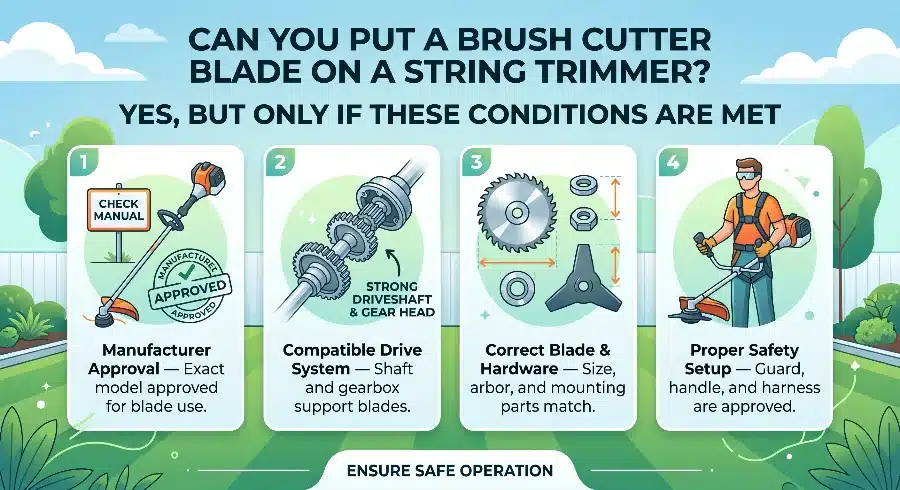
You can put a brush cutter blade on a string trimmer only if the manufacturer approves blade use for that specific model. The blade, mounting hardware, drive system, guard, handle, and any required harness must also match the manufacturer’s specifications.
In other words, a blade that fits over the mounting point is not necessarily a blade the trimmer can operate properly. Some string trimmers accept an approved brush cutter conversion kit. Others are designed only for trimmer line or a limited range of cutting attachments.
The checks below will help you tell which type of machine you have.
Start With the Exact Model and Manufacturer’s Approval
You will want to start with the owner’s manual. Search the manual and the manufacturer’s website for blade attachments, brush cutter accessories, conversion kits, or approved cutting attachments. If the manufacturer names a specific blade, kit, or configuration for your model, that is the setup to follow.
The exact model number matters. Two trimmers from the same brand may look nearly identical and still use different gearheads, guard mounts, or drive components. Approval for one model does not automatically apply to the other, no matter how similar they appear in a video or product photo.
Check the Shaft and Drive System
The shaft can give you a clue, but not an answer. Straight-shaft trimmers are much more likely to accept blade attachments, while curved-shaft models usually offer fewer metal-blade options.
Still, a straight shaft alone does not clear a trimmer for blade use. The gearbox and drive mechanism also have to be designed to transfer power to a rigid blade rather than flexible line. This is why two straight-shaft trimmers can have different attachment capabilities.
Match the Blade and Mounting Hardware
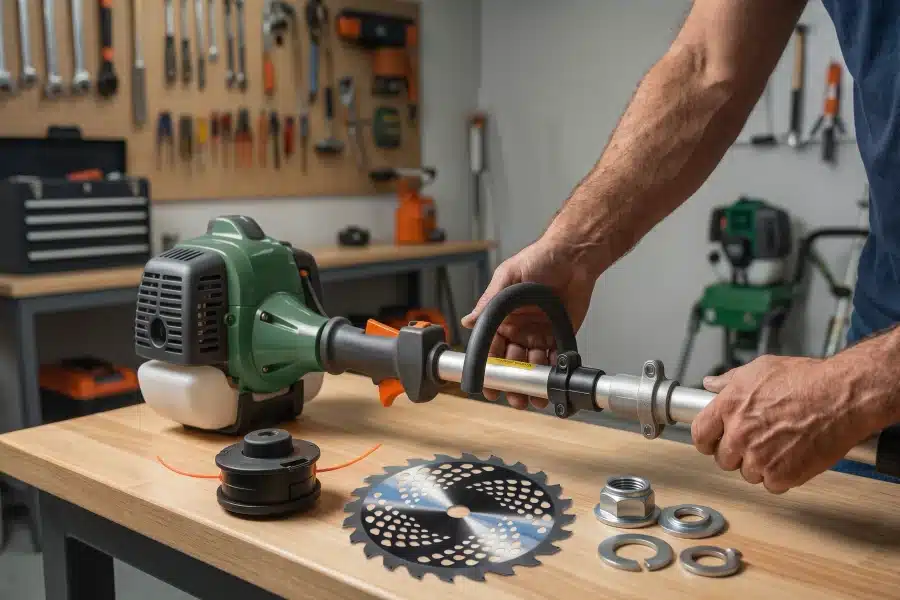
Once you know the trimmer is approved for blade use, check whether the blade itself matches the machine. The arbor is the hole at the center of the blade that fits over the mounting point. Its size must match the manufacturer’s specification, along with the approved blade diameter and any other listed dimensions.
The mounting hardware matters too. Drive plates, washers, flanges, retaining nuts, and adapters all help the blade sit squarely and remain centered. A missing or incorrect part can lead to poor seating, loosening, or excessive vibration. If the trimmer requires a conversion kit, use the parts specified for that model rather than assembling a similar-looking combination yourself.
The blade’s maximum RPM rating must also be suitable for the trimmer’s output speed. Maximum RPM is the blade’s limit, not a speed the machine must try to reach.
Check the Guard, Handle, and Harness
Some blade-approved trimmers require a different guard, a barrier bar or bicycle-style handle, and a shoulder harness. These are not optional extras added only for comfort. They are part of the configuration used to control the machine and maintain distance from the blade.
This is the point that is easy to miss: the trimmer, blade, mounting pieces, guard, and control equipment need to work together. If the manufacturer approves that complete setup, you have a sound basis for the conversion. If it approves only a particular blade or attachment kit, do not fill in the remaining details with guesswork.
Looking for a Brush Cutter Blade?Once machine compatibility has been confirmed, PagtonPro Tools can customize TCT and hardened steel brush cutter blades based on your required dimensions, bore size, tooth configuration, branding, and packaging.
Does the Trimmer’s Power Source Determine Blade Compatibility?
No. Whether a string trimmer is gas-powered, battery-powered, or corded does not determine blade compatibility by itself. The manufacturer’s approved attachments and the machine’s complete drive system matter more than its power source.
Gas-powered trimmers often have more attachment options, but not every gas model accepts a metal blade. Some battery trimmers are designed for interchangeable cutting attachments, while others are made solely for string trimming. Corded models may offer fewer options, but the same rule applies: check the exact model rather than assuming based on how it is powered.
Power source can help narrow the search. It cannot give you the final answer.
Can an Adapter Make a Brush Cutter Blade Fit a String Trimmer?
An adapter can help mount an approved blade, but it cannot turn an incompatible string trimmer into a brush cutter. Mounting the blade and having a machine designed to operate it are two separate issues.
If the manufacturer allows blade use, it may offer a conversion kit with the correct adapter, nut, washer, or drive plate. A universal adapter may make the arbor fit, but it cannot change the trimmer’s gearbox, operating limits, guard, or handle requirements.
That is why making an adapter or modifying the mounting hardware is not a sensible shortcut. First confirm that the trimmer accepts a blade; then select the proper mounting parts. Once compatibility is established, How to Choose the Right Brush Cutter Blade can help you choose a blade for the material you need to cut.
What Happens If You Use an Incompatible Blade?
An incompatible blade may cause excessive vibration, stress on drive components, unstable operation, loss of control, or blade detachment. The risks depend on what is mismatched, but a blade being easy to attach does not make the setup suitable.
A blade that does not sit squarely can wobble as it spins. A blade outside the approved size or weight can place loads on the clutch, shaft, gearbox, or motor that the machine was not designed to carry. The wrong guard or handle can also make the trimmer harder to control, especially if a rigid blade catches on solid material rather than flexing away like trimmer line.
This is why compatibility is about more than whether the blade will cut. It is about whether the complete machine can drive, retain, and control that blade as intended.
What Should You Do If the Manual Does Not Mention Metal Blades?
If the owner’s manual does not mention an approved metal blade or conversion kit, do not assume the string trimmer is compatible. Check the manufacturer’s website or ask the manufacturer or an authorized dealer about the exact model.
Pay attention to the wording of the answer. Approval for one blade size or one kit is not blanket approval for every blade with the same arbor. The same applies to another trimmer from the same brand.
If you cannot confirm an approved setup, keep using the permitted cutting attachment or use a dedicated brush cutter for the heavier work. If the model is approved but you are unsure which blade you need, Brush Cutter Blade Types and Uses explains the practical differences.
Final Compatibility Checklist
Before installing a brush cutter blade, confirm the complete setup rather than relying on one promising feature such as a straight shaft or matching arbor.
- The exact trimmer model is approved for blade use.
- The blade type, diameter, dimensions, and maximum RPM rating meet the manufacturer’s specifications.
- The arbor and all mounting components are compatible.
- The shaft, gearbox, and drive system support blade operation.
- The specified guard, handle or barrier bar, and harness are fitted.
- The blade is seated and secured according to the model’s instructions.
If every item checks out, then yes, your string trimmer can use a brush cutter blade in the approved configuration. Use the manufacturer’s recommended parts and follow the instructions for your model. If any part remains uncertain, stop and verify it before making the conversion. With a rigid blade spinning at speed, guessing simply is not worth it.