If you’re standing in front of overgrown grass, a wall of brambles, or a patch of young saplings, one question usually comes to mind: Can a brush cutter handle this, or is it too thick?
The answer depends on what you’re cutting. Grass and herbaceous weeds are very different from vines. Young softwood saplings are different again from dense hardwood stems. This guide breaks down the approximate cutting thickness for each type, so you can get a realistic idea of where a brush cutter fits and when another tool may be a better choice.

Table of Contents
- How Thick Can a Brush Cutter Blade Cut?
- How Thick Can a Brush Cutter Blade Cut Grass and Herbaceous Weeds?
- How Thick Can a Brush Cutter Blade Cut Vines and Brambles?
- How Thick Can a Brush Cutter Blade Cut Softwood?
- How Thick Can a Brush Cutter Blade Cut Hardwood?
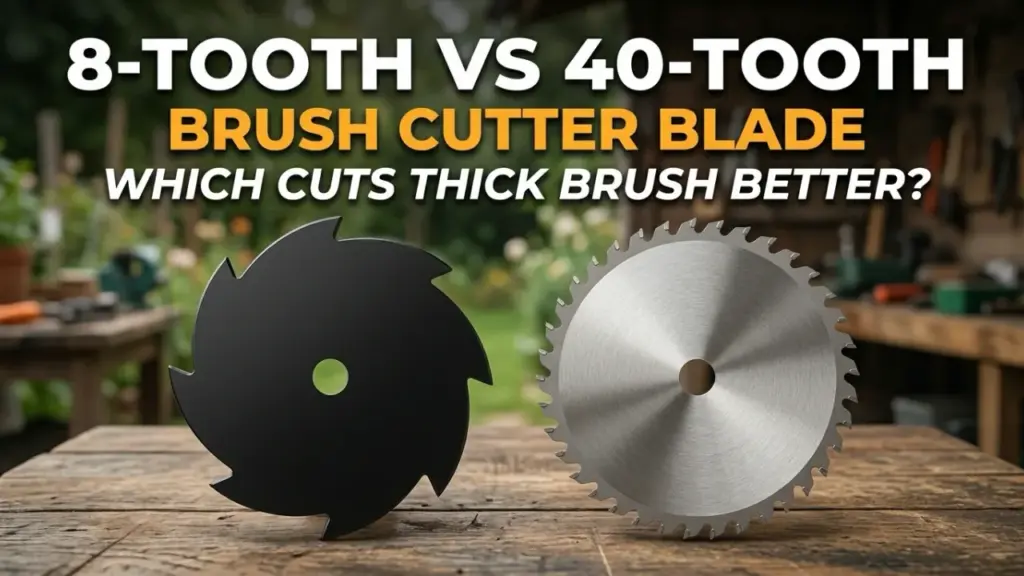
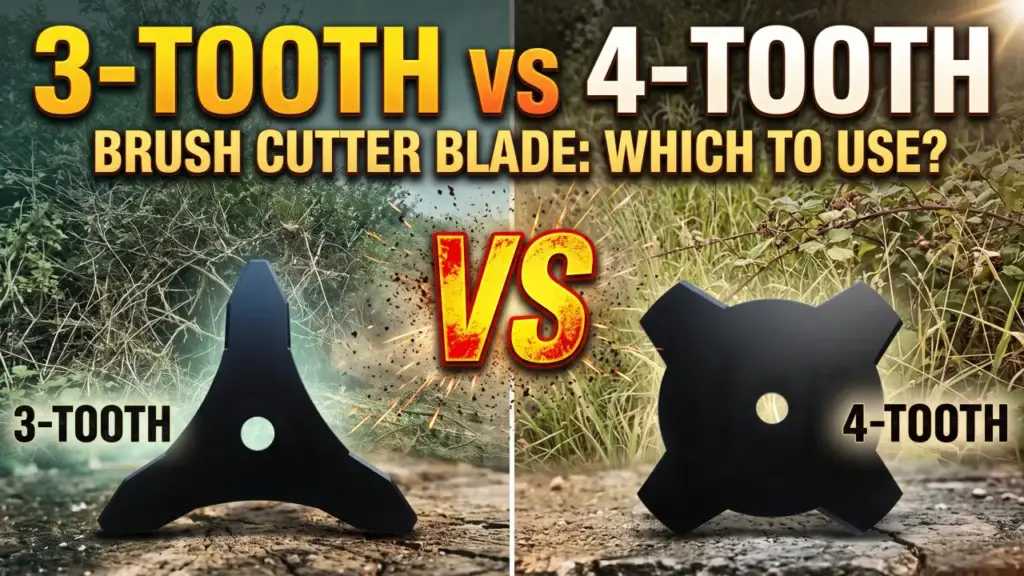
- Does Blade Tooth Count Affect How Thick It Can Cut?
- When Is a Stem Too Thick for a Brush Cutter?
- Conclusion
- FAQs About Brush Cutter Cutting Thickness
How Thick Can a Brush Cutter Blade Cut?
A brush cutter blade can handle everything from fine grass and weeds to small woody stems. As a general reference, grass and herbaceous weeds are usually under about 1 inch. Vines and brambles can fall around 1/2–1 inch when they become woody. Small woody stems are commonly in the 1–2 inch range for brush-cutting work.
These numbers are practical reference ranges, not universal cutting limits. Extension and forestry guidance places brush saws and clearing saws among tools used for small-diameter woody vegetation. The actual cutting capacity still depends on the blade, machine, vegetation, and cutting conditions.
Brush Cutter Blade Cutting Thickness by Vegetation Type
| Vegetation Type | Approximate Thickness to Consider | What Usually Limits the Cut |
|---|---|---|
| Grass & herbaceous weeds | Under about 1 in. | Density, toughness, and how much vegetation enters the blade at once |
| Vines & brambles | Around 1/2–1 in. for lighter woody growth | Flexibility, tangling, and stem toughness |
| Softwood shrubs & young saplings | Around 1–2 in. on suitable machines | Wood density, blade design, and machine power |
| Hardwood stems & saplings | Around 1–2 in. can be possible, but more demanding | Wood density, dryness, blade design, and machine power |
| Larger woody growth | Beyond the range of many brush-cutting applications | Blade rating, machine capacity, and tool suitability |
The ranges above are meant to give you a useful sense of scale, not a universal cutting limit. Forestry guidance places brush saws and clearing saws in the category of tools for small-diameter woody vegetation. References from UC ANR and the University of Minnesota Extension commonly describe brush-saw work around the small-sapling range. This includes stems around 1 inch and material below roughly 3 inches in diameter. Actual cutting capacity can vary substantially with the blade, machine, and vegetation. These figures should therefore be treated as general reference points rather than fixed limits.
Diameter is only part of the picture. Blade design, machine power, wood density, and vegetation density can all change the cutting experience. The way the blade meets the material also matters. Always give the specifications for the actual blade and brush cutter you are using priority over a general range.
Now let’s look at each type of vegetation more closely.
How Thick Can a Brush Cutter Blade Cut Grass and Herbaceous Weeds?
A brush cutter can generally handle the thin stems found in most grass and herbaceous weeds. Diameter is usually not the main limitation. Even when individual stems are well below 1 inch, a thick patch can still make the job surprisingly demanding.
There’s a big difference between cutting a few tall weeds along a driveway and moving through a dense patch that has been growing unchecked for months. The individual stems may not be especially thick. The problem is that much more material reaches the blade at once.
Some weeds are also tougher and more fibrous than others. A soft, flexible stem may slice through easily. A fibrous weed can resist the blade more than its size suggests.
So when you’re cutting ordinary grass and herbaceous weeds, look at density and toughness as much as stem diameter. The 1-inch figure in the table is only a rough reference. It is not the point at which grass suddenly becomes too thick for a brush cutter.
How Thick Can a Brush Cutter Blade Cut Vines and Brambles?
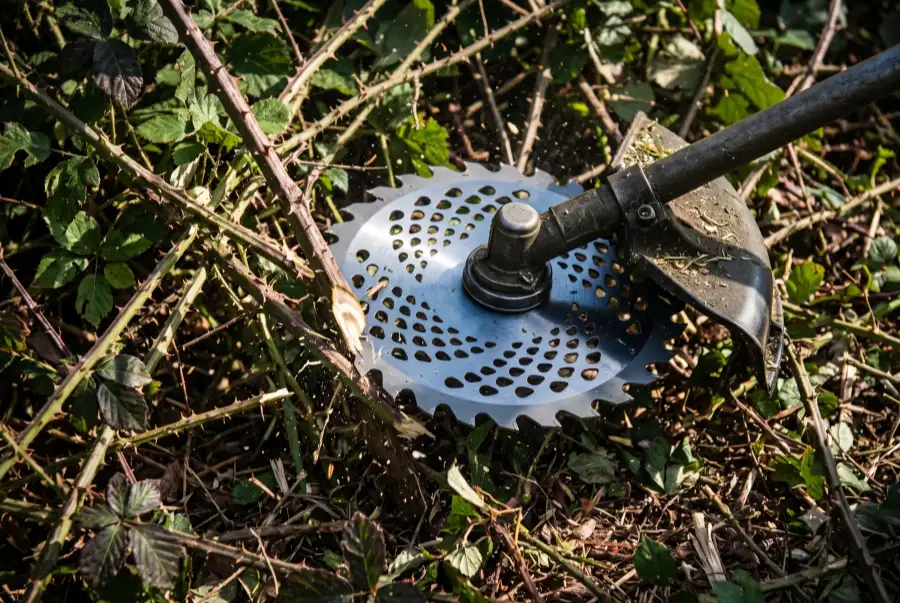
A brush cutter can generally handle vines and brambles around 1/2–1 inch thick when the growth is still relatively light and woody. These plants can become difficult before diameter alone becomes a problem.
The reason is simple: vines move.
A rigid stem stays in place when the blade approaches it. A vine can bend away or wrap around nearby growth. It can also get pulled into the cutting area instead of giving the blade a clean, predictable cut.
Brambles add another layer of difficulty. Their canes can become woody while the surrounding growth remains tangled.
A 1/2-inch cane standing on its own is a very different job from a 1/2-inch cane buried in a dense tangle. The diameter is the same. The cutting conditions are not.
That’s why the 1/2–1 inch range should be viewed as a reference for lighter woody vines and brambles, rather than a strict limit. Older, denser, or heavily tangled growth can be much harder to clear.
How Thick Can a Brush Cutter Blade Cut Softwood?
A brush cutter designed for woody vegetation can generally work with softwood shrubs and young saplings around 1–2 inches in diameter when the machine and cutting attachment are appropriate for the job. Forestry guidance also places brush saws and clearing saws among tools used for small-diameter saplings.
This is where the job starts to feel noticeably different from cutting grass.
A 2-inch sapling has much more wood behind it than a thin weed. You cannot treat it like a tall weed and expect the same cutting action.
The stem itself also matters. Density, moisture, age, and condition can change how much resistance the blade encounters.
For that reason, 1–2 inches is better understood as a small-sapling working range than a guaranteed maximum. Larger woody stems may require a different approach. At that point, the question is not only whether the blade can cut the stem. You also need to ask whether a brush cutter is the right tool for the job.
How Thick Can a Brush Cutter Blade Cut Hardwood?
A brush cutter can handle some hardwood stems in roughly the 1–2 inch range. However, hardwood can become a more demanding cutting job as stem diameter increases.
It is also important not to treat all hardwood as equally difficult to cut. “Hardwood” is a botanical classification. It does not mean every hardwood species has the same density or mechanical properties.
Wood density, moisture, species, age, and condition can all affect cutting resistance.
A 1-inch hardwood stem is therefore not automatically harder to cut than every 1-inch softwood stem. Diameter alone does not tell you how difficult the cut will be.
The 1–2 inch figure works best as a general reference for small hardwood stems. It is not a universal capacity rating. As stems become larger or denser, the cutting demand increases. A brush cutter may also become less appropriate for the job.
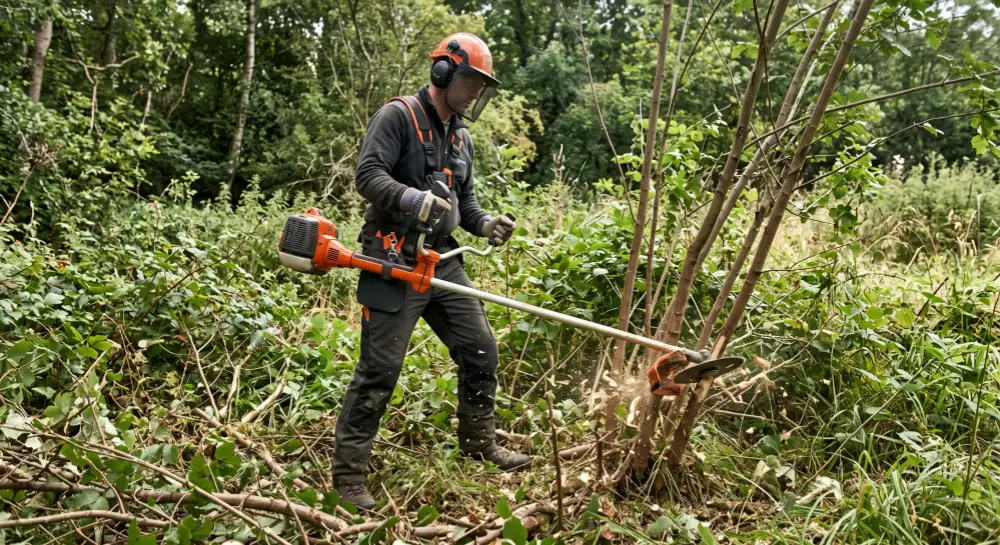
Does Blade Tooth Count Affect How Thick It Can Cut?
Yes, tooth count can affect how a blade handles vegetation. However, tooth count alone does not determine how thick a stem the blade can cut.
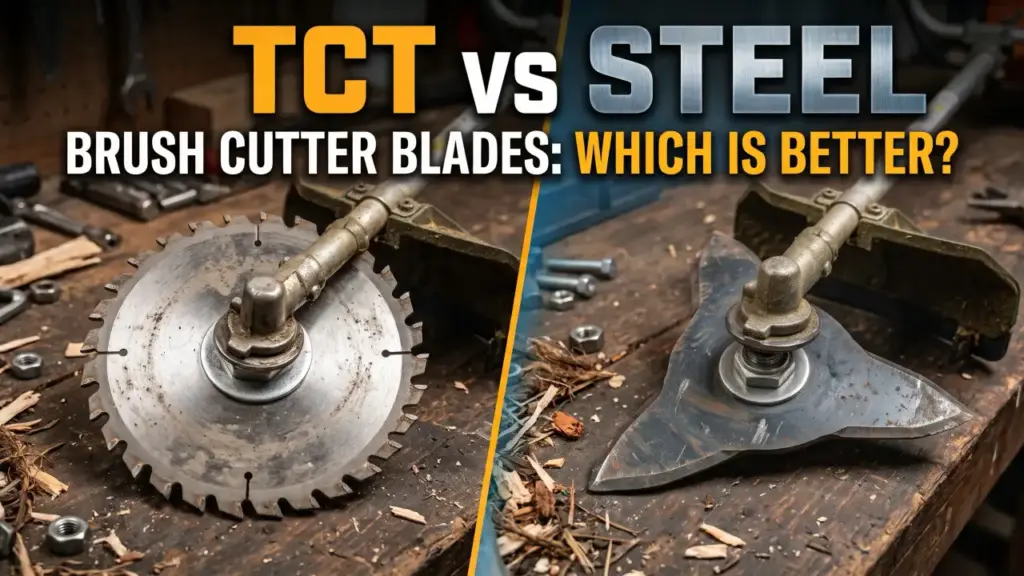
The complete blade design matters. So do the cutting edge, blade material, tooth shape, and the way the teeth engage the vegetation.
Machine power matters too. The machine needs enough power to keep the blade working effectively as resistance increases.
That’s why you should not assume that more teeth—or fewer teeth—automatically means a blade can cut thicker stems. The intended cutting application and the complete blade design are better indicators.
When Is a Stem Too Thick for a Brush Cutter?
A stem is too thick for a brush cutter when the blade and machine are no longer intended to handle that material safely and effectively. There is no single diameter that makes every brush cutter unsuitable.
As a practical rule, consider another cutting tool once woody stems move well beyond the small-sapling range. Do not simply push the brush cutter harder. Extension guidance also distinguishes brush cutters and clearing saws used for smaller woody material from equipment intended for larger woody vegetation.
Pay attention to how the equipment behaves. If the blade struggles to maintain effective cutting performance, you have to force it into the stem, or you keep attacking the same piece of wood, the material may be outside the sensible working range.
The goal is not to find the biggest stem a brush cutter can cut once. The goal is to stay within a range where the machine and blade can do the job effectively and appropriately.
Conclusion
A brush cutter does not have one universal cutting thickness. Grass and weeds are usually limited more by density and toughness. Vines and brambles can be difficult because of flexibility and tangling. Woody stems depend more on diameter, wood properties, blade design, and machine capacity.
As a general guide, think of under 1 inch for grass and herbaceous growth, 1/2–1 inch for lighter woody vines and brambles, and around 1–2 inches for small woody stems. Treat these numbers as practical reference points. Then check the specifications for your specific blade and brush cutter before tackling larger or denser woody growth.
FAQs About Brush Cutter Cutting Thickness
It can be possible when the blade and machine are designed for small woody stems. However, 2 inches should not be treated as a universal limit. Wood type, density, condition, blade design, and machine capacity all affect the result.
Blade diameter can influence how a blade performs. However, it does not establish a maximum stem diameter by itself. The complete blade design and the machine driving it matter more.
Yes. A dull edge can increase resistance and make woody vegetation harder to cut cleanly. A thick stem that already challenges the equipment can become even more difficult with a dull blade.
A brush cutter may handle some smaller bamboo stems with the appropriate cutting attachment. Bamboo can be tough and fibrous, though, especially as the stems become larger. Stem size and the specific equipment should be considered together.
Yes. The way the blade meets the stem can affect how effectively it cuts. A controlled approach can help the blade engage the material more effectively, while an awkward angle can make the cut less efficient.