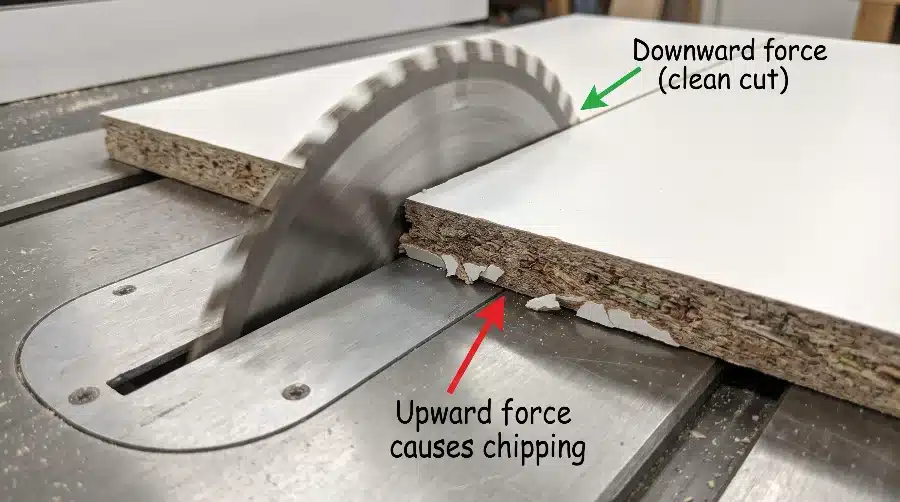
Most people evaluate a melamine cut by looking at the face they see. However, when cutting melamine on a table saw, that is the wrong face to evaluate. The teeth enter the melamine from the top. However, they exit through the bottom, and that exit face is where melamine chips.
For the purposes of this article, we will focus on one application: melamine-faced panels on a table saw with no scoring unit. A scoring unit is basically a smaller second blade that scores the underside coating just ahead of the primary blade.
In this article, we will discuss how Hi-ATB and TCG grinds deal with melamine and where each grind has its place. We will also discuss wear, underside chipping, and zero clearance inserts.
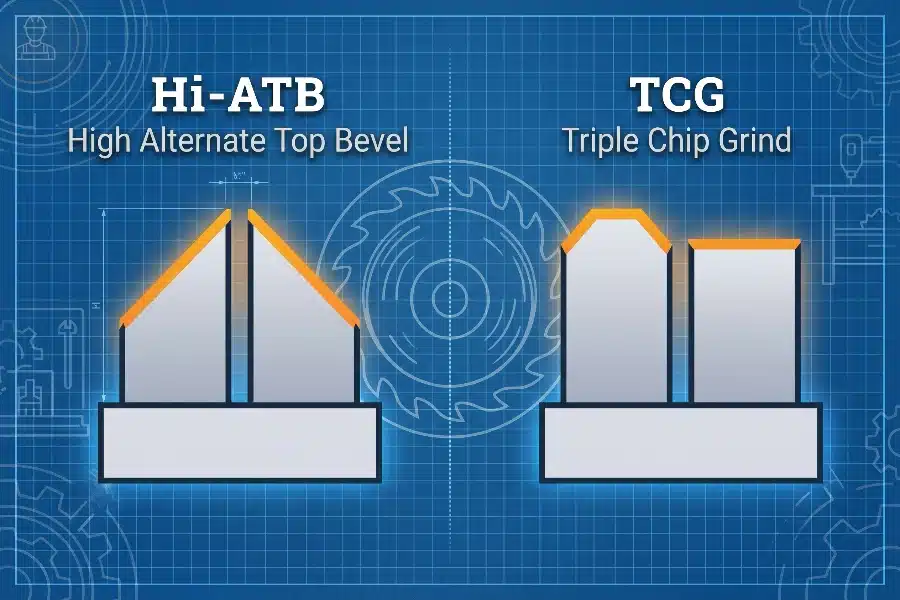
Table of Contents
- Why Does Cutting Melamine Without a Scoring Unit Change the Blade Choice?
- What Are Hi-ATB and TCG Teeth?
- How Do Hi-ATB and TCG Compare for Melamine Faced Panels?
- Which Geometry Wears Better, and How Does Sharpening Differ?
- Why Can the Top Face Be Clean While the Bottom Face Chips?
- When Does a Zero Clearance Insert Help?
- Conclusion
- FAQs
Why Does Cutting Melamine Without a Scoring Unit Change the Blade Choice?
Because the main blade now cuts the bottom coating by itself, right where that coating has the least support.
Melamine-faced board is decorative paper that has been saturated with melamine resin and then applied to a core with heat. The core is typically particleboard, MDF, or plywood. The cured resin is rigid and glass-like. So where wood fibers flex, melamine cracks and flakes off.
Remember that a table saw blade rotates toward you. That means its up-cutting teeth are traveling down into the panel. On their inward stroke they are pushing down on the top laminate, forcing it tightly against the core. But on the return stroke, they are pushing up on the underside laminate, forcing it away from the core. The only thing resisting that force is the thickness of the table insert itself.
What Are Hi-ATB and TCG Teeth?
They each solve the same problem: cutting a brittle coating without tearing it away from the material underneath.
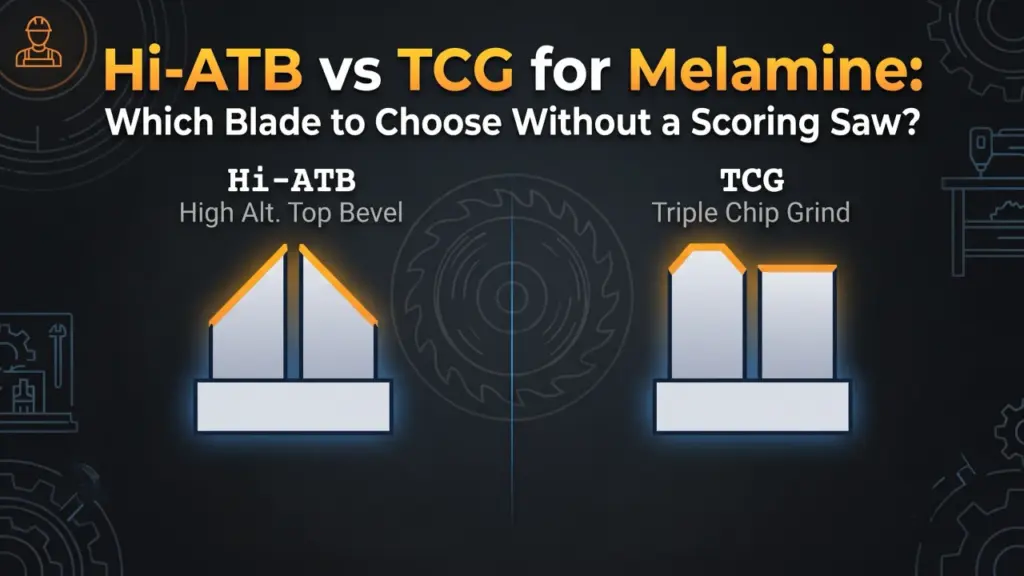
Hi-ATB (“high alternate top bevel”) grinds every tooth at a steep angle, with a sharp corner at the peak. The corners point alternately left and right, each cutting one side of the kerf. It’s almost like scoring both sides with the tip of a knife before the rest of the tooth removes the middle.
TCG (“triple chip grind”) divides the labor. A tall chamfered tooth cuts the center of the kerf; a shorter flat tooth on the opposite side expands it to full width. No single tooth has to remove the full kerf width of material by itself. For how these grinds compare on other materials, see ATB vs FTG vs TCG saw blades.
How Do Hi-ATB and TCG Compare for Melamine Faced Panels?
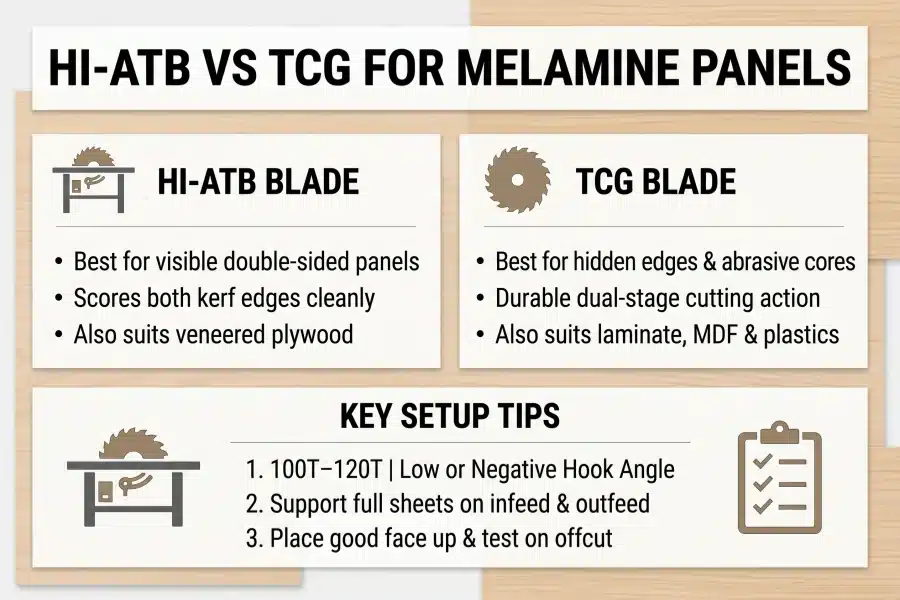
Since both grinds show up on blades marketed for melamine, perhaps the better question is what faces will users encounter? Blades designed for cutting melamine, regardless of grind type, typically have a high tooth count and a low or negative hook angle. That low angle discourages the blade from pulling the panel through during cutting. Beyond that, Hi-ATB blades often include veneered plywood in their scope while TCG blades target laminate, MDF, plastics, and nonferrous metal. It is important to note that these lists reflect the manufacturer’s intent, not how any particular blade will cut on your saw.
Both faces get equal time on open shelving or the inside of a cabinet side. That’s where Hi-ATB gets most votes since those points tend to score each edge of the kerf before the coating lifts. A cabinet back or panel bottom that will face a wall gets little cosmetic benefit from small bottom chips. Nor will visibility be a concern if the melamine is cut into an assembled panel. Then TCG’s dual-stage cut may cope better with abrasive cores. Finally, neither choice offers a guarantee, as shop results can vary widely for reasons beyond tooth geometry. Each cut reflects one saw, one batch of board, and one blade at a particular point in its life.
Improper cuts won’t redeem themselves with edgebanding. Banding covers the raw edge, but a chip that curls onto the face will remain visible next to the banding.
To get the best results with either blade type, prepare the job properly. Install a sharp, clean blade, and support full sheets on both the infeed and outfeed sides to keep them from sagging. Load the job with the most important face on top, then confirm your settings on an offcut from the same sheet of melamine. Some table saw blades include melamine-faced panels in their marketing materials. You’ll find that range from 100T to 120T in widths from 10″ to 16″.
Which Geometry Wears Better, and How Does Sharpening Differ?
Tooth design, carbide quality, hook angle and the quality of the abrasive in the core all have an impact on wear. Particleboard and MDF cause carbide to wear in a predictable manner, abrading at the cutting edges as solid wood rarely does.
With a Hi-ATB tooth, the cut is focused to an extremely small area. Once this point is rounded over, the scoring action on the bottom face is gone, and chips will start to appear on the bottom face first. The performance of TCG blades will typically deteriorate more slowly since both shapes are sharing the cutting load. These are generalizations in geometry and not scientific wear tests; therefore, neither will perform better in all situations.
Each grind calls for specific considerations from sharpening service. Matching the sharpening angle on every tooth is critical to a Hi-ATB blade’s points scoring evenly. The difference in height between the two shapes is very important to the performance of the TCG blade, as it divides the cutting forces. Either way, check first to see if the service you select has experience with that grind.
Additionally, check for buildup first. Dried resin and glue can make a sharp blade dull. Our posts guide on how to clean circular saw blades and how to know if your circular saw blade is dull walks you through all the necessary steps. To learn what a regrind can realistically restore, see Can a circular saw blade be sharpened?
Why Can the Top Face Be Clean While the Bottom Face Chips?
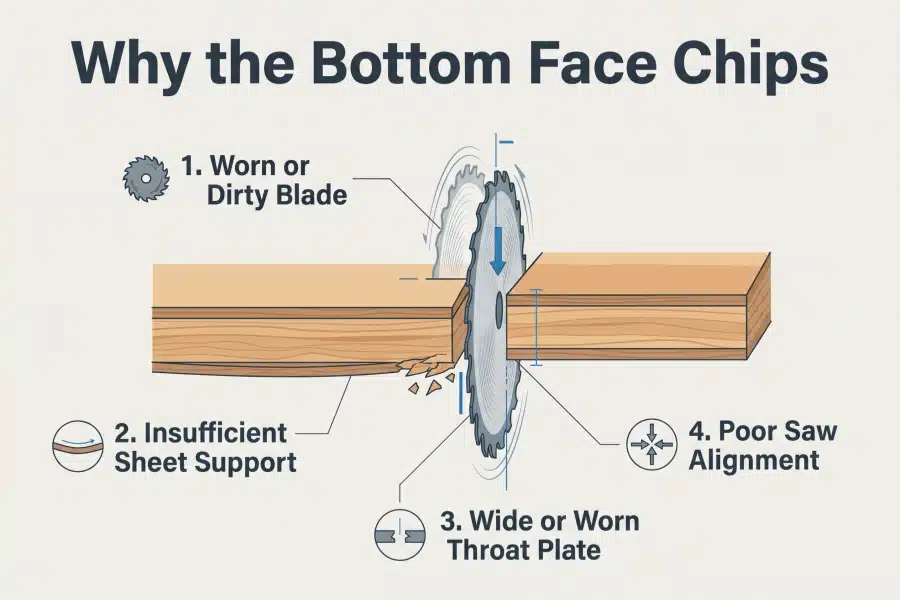
Regardless of grind pattern, any weakness in the setup will show up in the bottom face first. A chipped underside beneath a clean top is a symptom, with grind pattern being only one of many possible causes.
Blade condition can be overlooked because a blade can look fine while still being worn. Rounded tips, a chipped tooth, or even a coating of resin will reduce exit cutting power before the top edge shows wear. Runout from dirty flanges or a bent arbor does the same by allowing the teeth to wander.
Support is another concern when ripping full sheets. A sheet can sag or lift during a cut, which changes the angle of the exit teeth. Infeed and outfeed support will keep the sheet from moving, ensuring a consistent exit from beginning to end.
Inspect the insert as well. Since it supports the coating at exit, a wide or worn opening will allow the coating to lift away instead of cutting cleanly.
Poor machine setup can cause undersides to chip as well. Blade height set outside the manufacturer’s specification, a fence not riding parallel, or even arbor runout can be causes. If the blade is clean and sharp yet the problem persists, check your saw’s alignment specifications. Adjust one thing at a time, then cut a new piece of scrap from the same sheet to ensure you know which adjustment fixed the problem.
When Does a Zero Clearance Insert Help?
Zero clearance inserts are only helpful if your saw manufacturer provides one or approves of you using one for your saw. They’re placed in a slot cut to match the kerf of your blade, so the bottom of the material is supported right up to the cutting edges.
Never remove the riving knife or guard, or alter either as suggested in the user manual. As soon as you widen the slot or change blades to one with a different kerf, the insert is no better than any other inserted into the saw. An insert merely reduces the gap. It can’t fix a dull blade, warped panel, or misalignment.
Conclusion
The best-looking melamine face is always going to be the top face. But without a scoring unit, the underside of the material is where you’ll see the true benefits of a melamine blade.
Let the finished part be your guide when choosing a blade. If both sides will be seen, then Hi-ATB is typically the way to go. If only one side will show, then TCG is up to the task and can handle abrasive material as well. Regardless of the blade you choose, it’s essential to have a plan to keep it sharp.
Don’t blame the grind yet if you see chipping on the underside. Check the blade, support, insert, and saw. For panel work that needs a specific tooth count, arbor, or branding, OEM customization is available.
FAQs
Yes, often it can. Hi-ATB blades are frequently sold for both uses since the veneer on plywood and melamine will chip off. Some ATB table saw blades refer to wood-based panels and MDF, but not melamine, so be sure to check the product description.
They are complementary to one another. Tooth count regulates the size of the bite the coating takes, and the tooth grind regulates the individual bites on the edge of the coating. We dive into circular saw blade tooth counts and what they mean for the cut in this article.
A thin kerf will do the job, but a thicker plate doesn’t flex as much, and that flex is what shows up as chipping on the bottom. Whichever you go with, match the riving knife thickness to the kerf as instructed in the manual. Check out our thin kerf vs full kerf circular saw blades article to see the trade-off in detail.
Not necessarily. If you’re leaving the coated face side up, the bottom side is exposed core, so chipping on the underside means you lose nothing that can be seen. You are then simply deciding whether or not you want to keep that one exposed edge nice.