Cutting laminate flooring looks simple enough, until you start getting chipped edges, burn marks, or a blade that seems to lose its sharpness much sooner than expected. A saw blade that works perfectly well on ordinary wood may not give you the same results on laminate.
So, what should you look for when choosing a blade for the job?
This guide explains which blade features matter when cutting laminate flooring and how to choose the right blade for a circular saw, miter saw, or table saw.
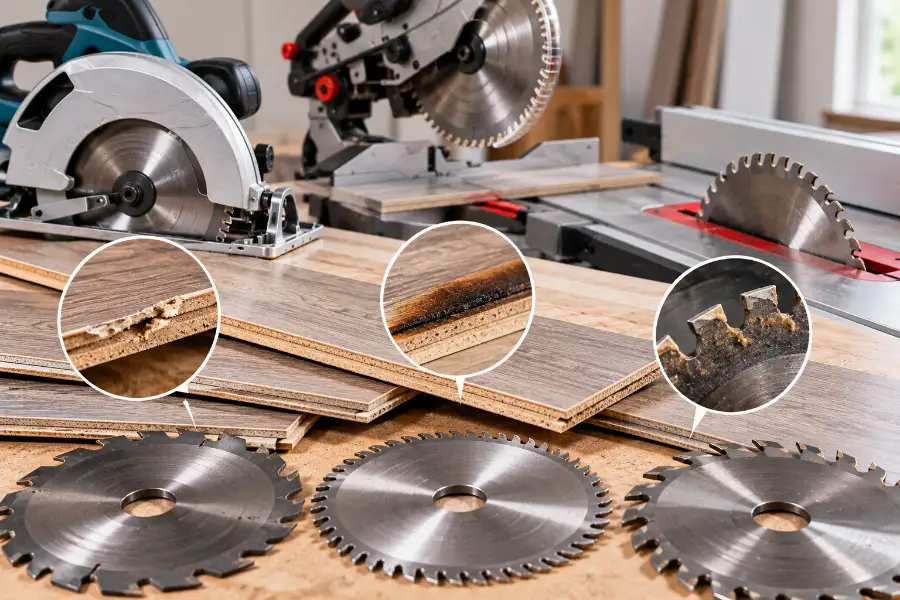
Table of Contents
- Why Is Laminate Flooring Hard on Saw Blades?
- Which Blade Specifications Matter Most for Laminate?
- Which Saw Blade Should You Choose for Each Saw?
- What Is the Best Circular Saw Blade for Laminate Flooring?
- What Is the Best Miter Saw Blade for Laminate Flooring?
- What Is the Best Table Saw Blade for Laminate Flooring?
- FAQs About Laminate Flooring Saw Blades
- Conclusion
Why Is Laminate Flooring Hard on Saw Blades?
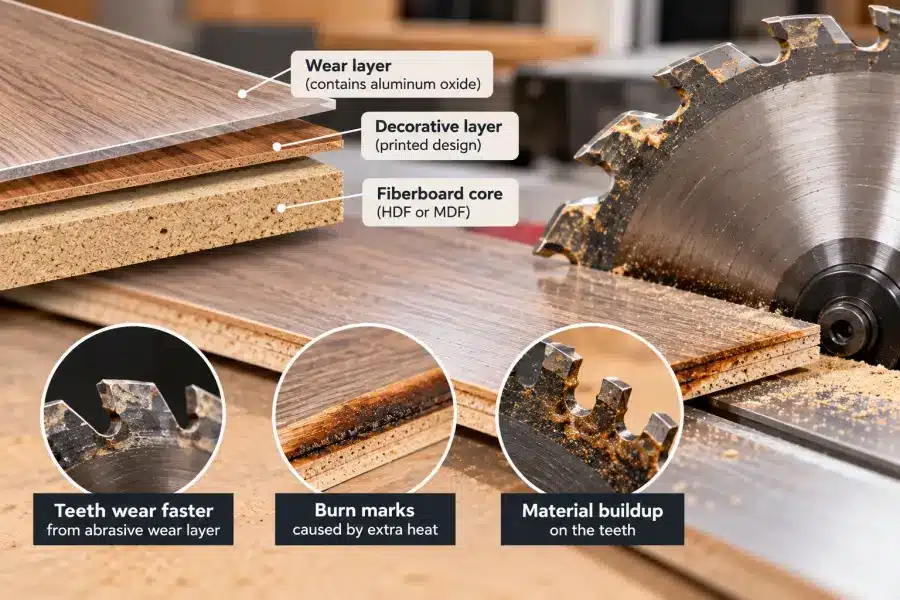
Laminate flooring wears down saw blades faster than ordinary wood because its protective wear layer contains hard, abrasive particles. Most laminate flooring has a fiberboard core, a printed decorative layer, and a wear layer containing aluminum oxide, a material also used in sandpaper.
Once the teeth become dull, they may start rubbing against the material instead of cutting cleanly. This creates extra heat, which can cause burn marks and material buildup on the teeth. You can go from clean cuts to burnt edges during a single flooring job.
If you notice buildup, check out our article on how to clean circular saw blades. Cleaning can remove residue, but it won’t restore worn cutting edges.
Laminate flooring can also be confused with other flooring materials. For instance, vinyl plank flooring often has a plastic or stone-plastic composite core. Heat-related melting or deformation can be a concern when cutting some vinyl products, while abrasive wear is a major concern with laminate.
That’s why you should choose a blade based on the flooring material, not just its appearance.
Which Blade Specifications Matter Most for Laminate?
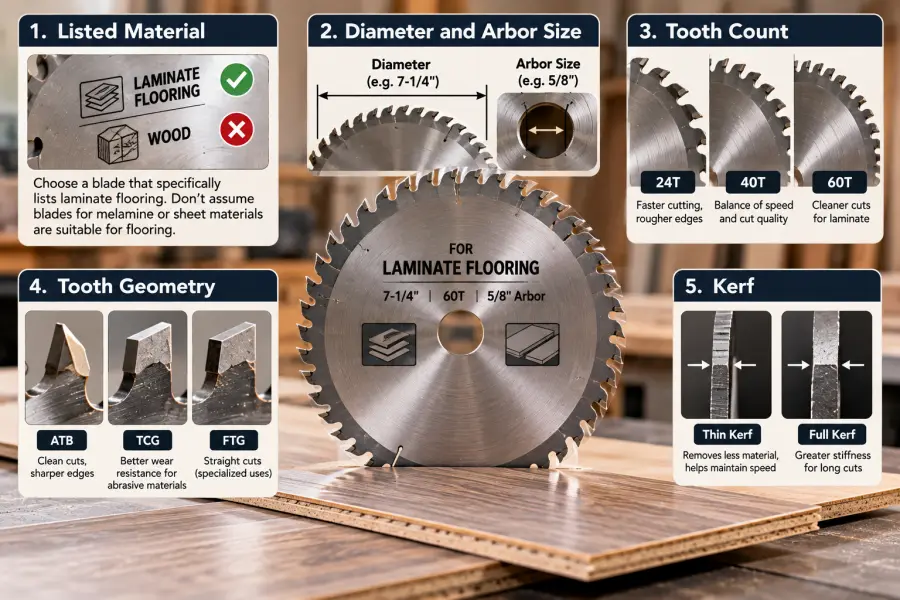
When comparing saw blades for laminate flooring, start with the materials they’re rated to cut and whether they fit your saw. Tooth count, tooth geometry, and kerf then help you narrow down the options based on cutting quality and performance.
Listed Material
Always check what materials the blade is designed to cut. Look for one that specifically lists laminate flooring.
You may also find blades labeled for melamine or laminate panels. These are generally made for sheet materials, so don’t assume they’re suitable for flooring. Check the manufacturer’s recommendations and make sure the blade is compatible with your type of saw.
Diameter and Arbor Size
The diameter and arbor size must match your saw’s specifications. The blade’s maximum rated speed must also be at least as high as the saw’s no-load speed.
For more guidance, see our article on Circular Saw Blade Arbor Size.
Tooth Count
More teeth generally mean each tooth removes less material, which can give you a cleaner cut. But a higher tooth count isn’t always better. It can also generate more heat if the blade isn’t clearing material efficiently or you’re feeding it too slowly.
Some flooring blades use fewer teeth with highly wear-resistant cutting edges. So there is no magic number for tooth count. The blade’s tooth design and material matter too.
Learn more about how tooth count affects your cut.
Tooth Geometry
Tooth geometry affects how cleanly the blade cuts and how long it stays sharp against abrasive materials.
Triple-chip grind (TCG) blades alternate chamfered and flat teeth to share the cutting work. This helps the cutting edges withstand wear. Blades with a higher alternate top bevel (ATB) can produce very clean cuts, but their sharper tooth points may wear faster.
Another thing to consider is hook angle. A lower or negative hook angle makes the cutting action less aggressive, helping reduce the tendency to grab the plank. The right angle still depends on the type of saw you’re using.
Read more about ATB, FTG & TCG tooth grinds and hook angle.
Kerf
A thinner kerf removes less material, which helps compact or battery-powered saws maintain speed during cutting.
On the other hand, a thicker blade plate can provide greater stiffness during longer cuts. But that doesn’t automatically make it better. Blade construction also affects how straight the blade cuts.
Learn more about thin kerf vs. full kerf blades.
Which Saw Blade Should You Choose for Each Saw?
For laminate flooring, circular saws often benefit from thin-kerf blades, miter saws need blades suited to controlled crosscuts, and table saws benefit from durable teeth and stable cutting performance during long rips.
Here’s a quick comparison to help you narrow down your choice.
Laminate Flooring Saw Blade Selection by Saw Type
| Saw Type | Recommended Blade | What to Prioritize | Best For |
| Circular Saw | Laminate-rated carbide blade, preferably thin-kerf for lower-powered saws | Wear-resistant teeth and low cutting resistance | Ripping the last row and making on-site cuts |
| Miter Saw | Laminate-rated carbide blade with a manufacturer-approved low or negative hook angle | Clean crosscuts and controlled cutting | Cutting planks to length and making angled cuts |
| Table Saw | Laminate-rated carbide blade with durable tooth geometry and stable plate construction | Edge durability and straight, consistent rips | Ripping multiple planks to width |
These recommendations are a starting point. The next three sections explain where each saw is most useful and why those blade features matter for the cuts you’ll be making.
What Is the Best Circular Saw Blade for Laminate Flooring?
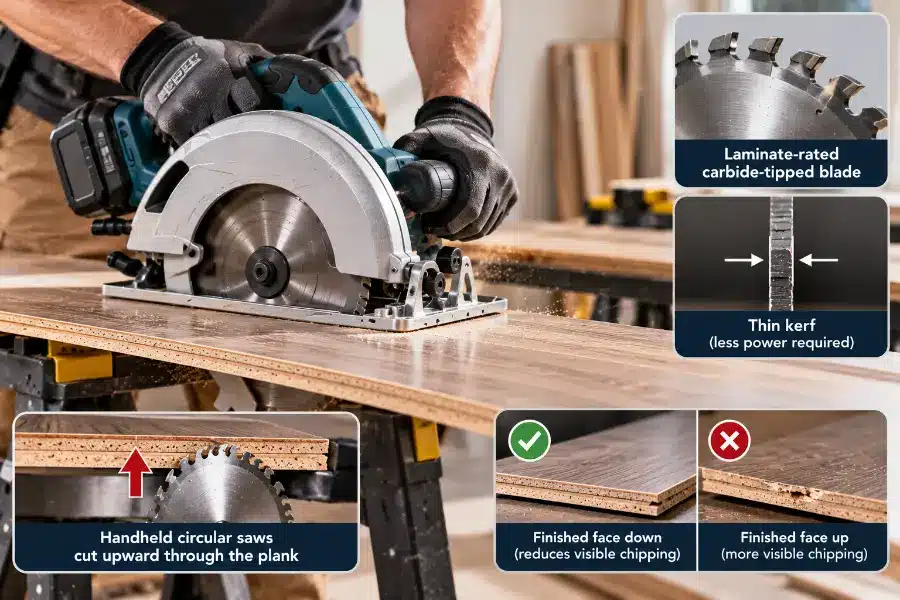
For a handheld circular saw, look for a laminate-rated carbide-tipped blade with a thin kerf, especially if you’re using a compact cordless model. The thinner cut requires less power, while the wear-resistant teeth help the blade hold up against laminate’s hard surface.
When you’re on a job site, your go-to tool will often be a circular saw. Think about it: you’re nowhere near your bench, but you need to rip the final row of laminate to size. Or you have boards that are too long for your miter saw.
When cutting long planks, keeping the workpiece steady matters. Movement or vibration during the cut can chip the laminate’s top layer.
One more thing: handheld circular saws typically cut upward through the plank. Placing the finished face down helps reduce visible chipping along the cut.
What Is the Best Miter Saw Blade for Laminate Flooring?
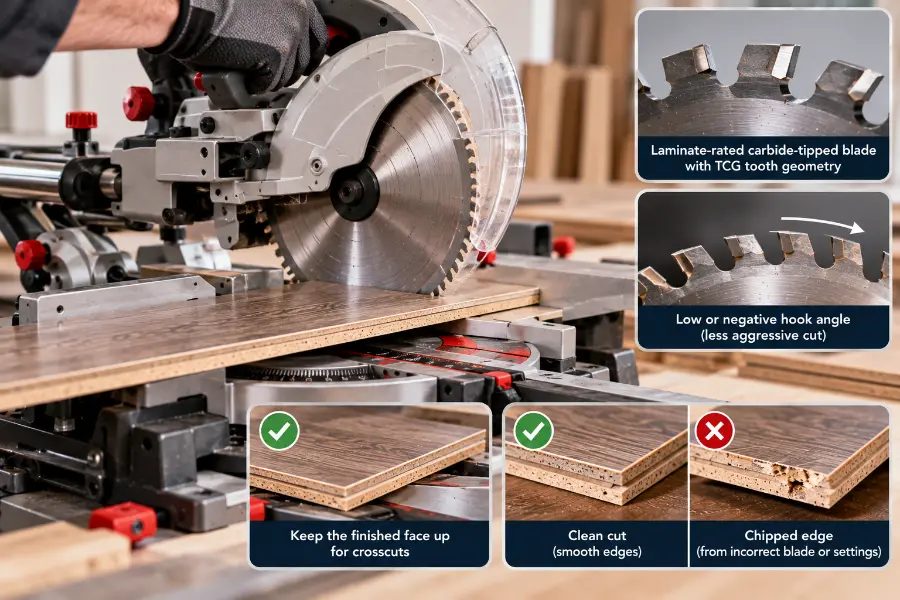
For laminate flooring crosscuts, look for a laminate-rated carbide-tipped blade with wear-resistant tooth geometry, such as TCG if recommended by the manufacturer. A low or negative hook angle is also worth considering, especially for sliding miter saws, provided the blade is approved for your saw.
A miter saw handles most crosscuts during a laminate installation. It cuts planks to length, trims end pieces against walls, and makes angled cuts around doorways and transitions.
You’ll need dozens of these cuts to finish a single room. Each one forces the teeth through the hard wear layer, gradually wearing down the cutting edges.
That’s why tooth design matters. A blade that stays sharp through repeated cuts helps keep the plank ends smooth, so the joints fit snugly and the finished floor looks neat.
Hook angle deserves particular attention on a miter saw, especially a sliding model. A more aggressive positive hook angle can increase the tendency to grab the plank, making the cut harder to control. A lower or negative hook angle generally produces a less aggressive cut.
For conventional downward crosscuts, keep the finished face up to help reduce visible chipping. Follow your saw’s cutting instructions, especially when using a sliding model.
What Is the Best Table Saw Blade for Laminate Flooring?
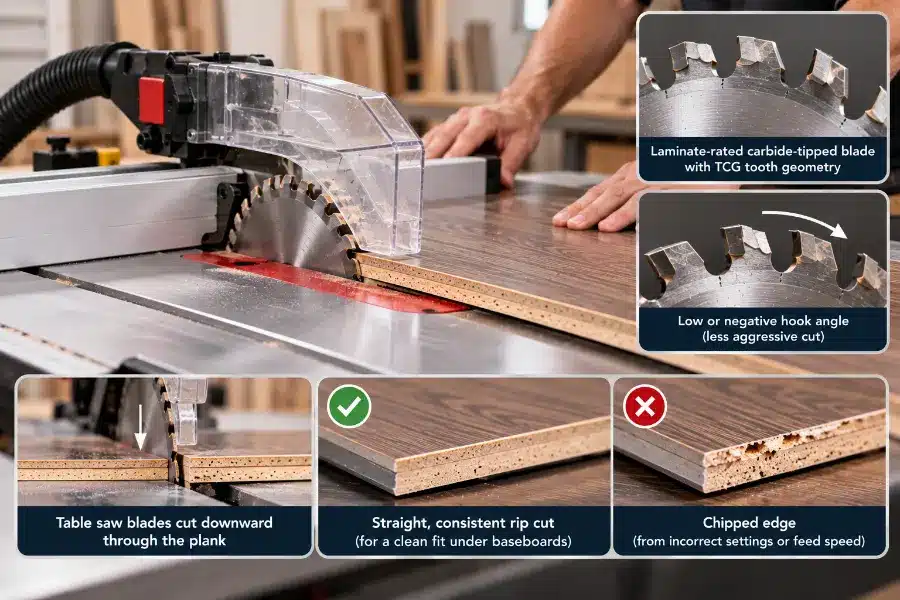
For ripping laminate flooring on a table saw, look for a laminate-rated carbide-tipped blade with wear-resistant tooth geometry, such as TCG if recommended by the manufacturer. The teeth need to stay sharp through repeated cuts, while the blade should be rigid enough to keep long rips straight and consistent.
Whenever you need to rip lots of planks to the same width, a table saw is your tool. It can also remove the tongues from the first row along the wall.
Even the blade plate matters. Why? Because a blade that flexes during cutting can leave an uneven edge. A well-made blade with a sufficiently stiff plate helps reduce that risk.
Most rip-cut edges will eventually sit against the wall under the baseboard. For jobs like these, a straight, consistent edge is usually more important than a perfectly polished finish.
When ripping on a table saw, feed the plank with the finished face up. The front cutting teeth move downward into the material, helping reduce visible chipping on the top surface.
FAQs About Laminate Flooring Saw Blades
Not necessarily. Melamine blades are often designed for coated panels, although some are also suitable for laminate flooring. Check the manufacturer’s listed materials and saw compatibility rather than relying on the word “laminate” alone.
Look for increased cutting resistance, burn marks, and edges that begin to chip more than before. Cleaning can remove residue, but it won’t restore a worn cutting edge. See our guide on how to tell if a circular saw blade is dull.
Possibly. Some flooring blades are designed for multiple materials, while others have more limited applications. Check the product description before using the blade on lumber.
Yes. Cutting laminate flooring releases fine particles from the fiberboard core and surface layers. Use suitable dust extraction, respiratory protection, and eye protection. Working outdoors may improve ventilation, but it doesn’t eliminate dust exposure.
Conclusion
Laminate flooring is harder on saw blades than ordinary wood, but that doesn’t mean you need the highest tooth count or the most expensive blade.
What matters is finding a blade that suits your saw, holds up against the abrasive wear layer, and delivers the cut quality your job requires. Pay attention to the finished face, too. Even a good blade can leave chipped edges if the plank moves or the cutting setup isn’t right.
For flooring manufacturers and professional cutting operations, standard blades may not always meet specific production requirements. We manufacture custom saw blades with tailored tooth counts, kerf widths, and hook angles. If you have a specific application in mind, contact us to discuss your requirements.