If you have a saw blade labeled for steel, you might expect it to cut stainless steel, too. After all, stainless steel is still steel. So why might you need a different blade, especially when your current one is still sharp and in good condition?
The answer comes down to more than the word “steel” on the blade label. Stainless steel can present different cutting challenges. In this article, we’ll explain why stainless steel can be more demanding to cut and which blade specifications to look at when deciding whether a steel-cutting saw blade is suitable for the job.
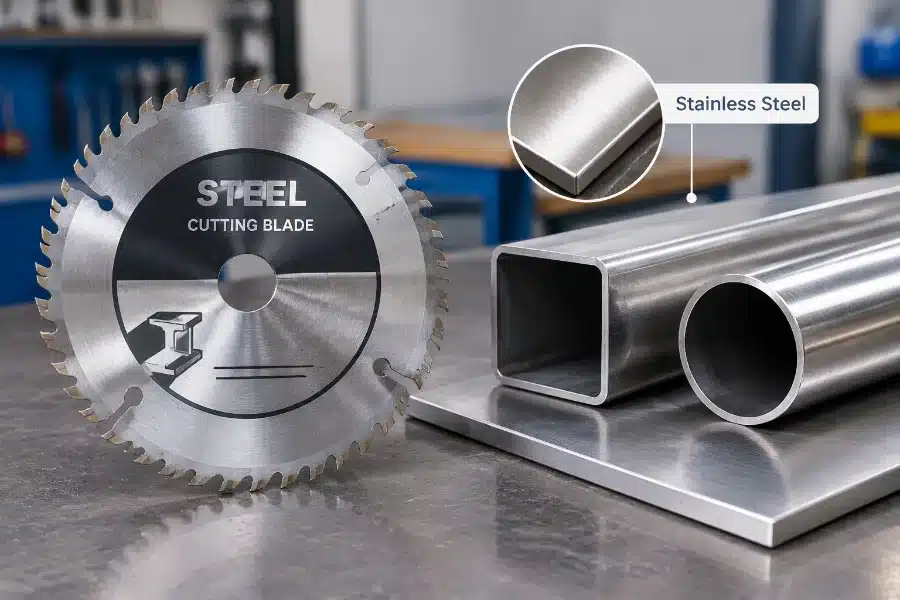
Table of Contents
- Does a Blade Rated for Steel Also Work on Stainless Steel?
- Why Does Stainless Steel Need Its Own Approval?
- How Do You Check Whether a Saw Blade Is Suitable for Stainless Steel?
- FAQs About Cutting Stainless Steel With a Saw Blade
Does a Blade Rated for Steel Also Work on Stainless Steel?
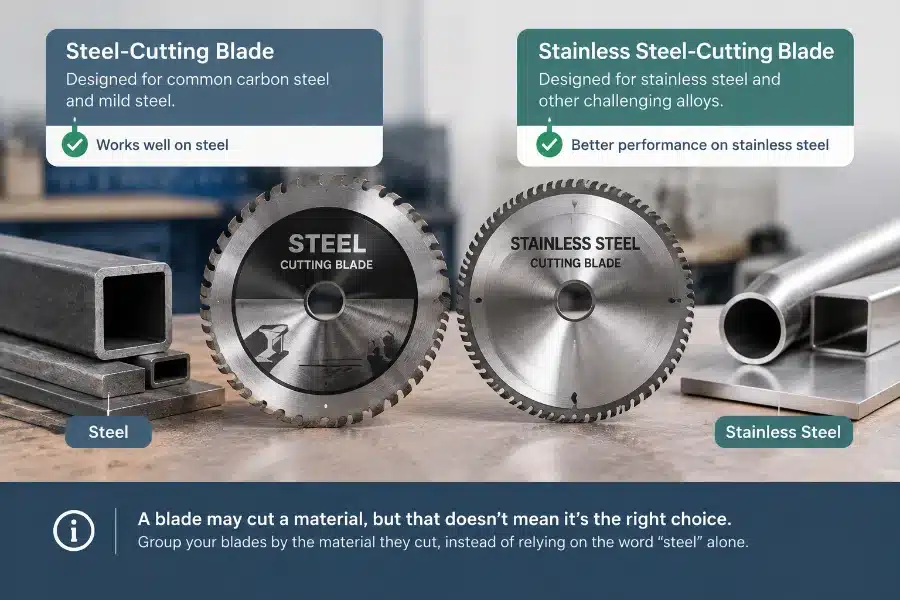
Not necessarily. A blade designed for ordinary steel may cut through stainless steel, but that doesn’t mean it will do the job well. The teeth may wear faster, the cut may become rough, or heat may build up during repeated cuts.
The key difference is between being able to cut a material and being designed to cut it reliably. A general “steel” label doesn’t tell you whether the blade is suitable for stainless steel.
The reverse can also be true. A blade designed for a particular type of stainless steel may not work well on structural steel because the materials and cutting requirements differ. That’s why it’s better to group your blades by the material they cut than rely on the word “steel” alone.
Why Does Stainless Steel Need Its Own Approval?
The challenge starts at the cutting edge. Many stainless steels conduct heat less effectively than ordinary carbon steels, so heat can build up around the cutting zone. Some grades, particularly austenitic stainless steels, also work-harden readily.
Work hardening happens when metal becomes harder as it undergoes plastic deformation. During cutting, a dull blade or unsuitable cutting conditions can cause the teeth to rub against the material instead of cutting cleanly. The deformed surface may then become harder for the next tooth to cut.
You may notice the problem before the teeth visibly fail. These signs can help you decide where to look first.
Table: Signs a Saw Blade May Be Struggling to Cut Stainless Steel
| What you notice | What it may indicate | Where to look first |
| The burr grows wider with each cut | The teeth may be rubbing or wearing | Tooth condition, feed technique, and material suitability |
| The cut face turns straw-colored or blue | Excessive heat may be building up | Recommended speed, feed, and cooling conditions |
| The blade squeals and feeding becomes difficult | The teeth may be dull or struggling with work-hardened material | Tooth condition and material suitability |
| Small chips or flat spots appear on the tips | The cutting edges may be chipping or wearing out | Stop cutting and inspect the teeth |
These signs are clues rather than definite diagnoses. If the cut becomes unusually difficult or the teeth show damage, stop and check the setup instead of forcing the blade through the material.
How Do You Check Whether a Saw Blade Is Suitable for Stainless Steel?
Once you know that a general steel rating isn’t enough to settle the question, the next step is to look at what the blade is actually designed to cut. A few details in the product specifications can help you narrow down whether the blade is a good match for stainless steel.
Confirm That Stainless Steel Is Listed as a Suitable Material
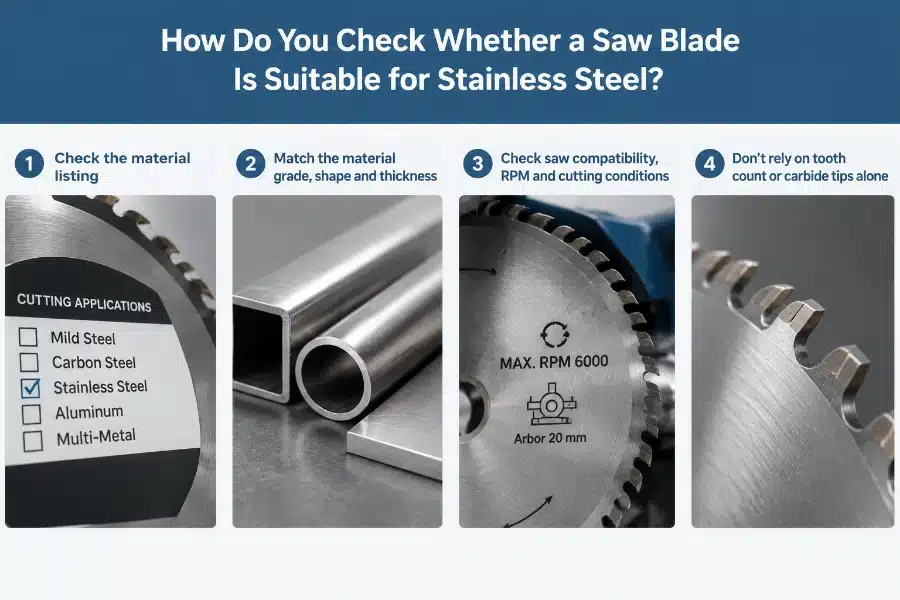
The first thing to look at is the blade’s stated cutting application. If stainless steel is specifically listed, you have a much clearer indication that the blade is designed for the job.
Terms such as “metal,” “ferrous metal,” or “multi-metal” are less specific. They cover broad material categories and don’t necessarily mean the blade is suitable for stainless steel. If the listing only mentions mild steel or carbon steel, it’s best not to assume that stainless steel is included.
Match the Stainless Steel Grade, Shape, and Thickness
Even when a blade is intended for stainless steel, the material you’re cutting still matters. Different stainless steel grades have different cutting characteristics, so suitability for one grade doesn’t automatically mean the blade will perform equally well on another.
The shape and thickness of the material are important, too. Cutting thin-walled tubing is different from cutting solid bar, even when both are made from the same grade of stainless steel. With tube and profiles, the tooth pitch needs to suit the wall thickness so the teeth engage the material appropriately. A blade that works well on one type of section may not be the right choice for another.
Check Saw Compatibility, RPM, and Cutting Conditions
A suitable blade also needs to work with your saw. Diameter, arbor size, mounting requirements, and machine type all affect compatibility, so a blade designed for stainless steel isn’t necessarily suitable for every metal-cutting saw.
RPM is another important distinction. The maximum RPM marked on the blade is a safety limit, not a recommended cutting speed. The saw’s operating speed must stay within that limit, while any separate speed, feed, or coolant recommendations for stainless steel need to be considered as well. Staying below the maximum RPM alone doesn’t guarantee suitable cutting conditions.
Don’t Rely on Tooth Count or Carbide Tips Alone
Tooth count and carbide tips can offer useful clues about a blade’s design, but neither confirms that the blade is suitable for stainless steel. Blades intended for different materials can have similar tooth counts, and carbide tips vary in their balance of hardness and toughness. Some metal-cutting blades use cermet, a ceramic-metal composite, instead.
What matters is how the tooth material and geometry work together for the intended application. A blade doesn’t become suitable for stainless steel simply because it has carbide tips or a high tooth count. For more background, see our guide to carbide-tipped vs. steel circular saw blades.
Ultimately, choosing a blade for stainless steel means looking beyond tooth count or tip material to the blade’s intended application. If you’re still unsure which blade fits your needs, sharing your stainless steel grade, material shape and thickness, and saw model with a supplier can help narrow down the options. If your application calls for a non-standard specification, you can also contact PagtonPro about a custom OEM blade.
FAQs About Cutting Stainless Steel With a Saw Blade
Not always. Some TCT metal-cutting blades are designed for dry cutting, while others recommend or require coolant. Follow the blade and saw instructions, and never use coolant with equipment that isn’t designed for it.
Not necessarily. Different stainless steel grades have different cutting characteristics, and a blade suitable for one grade may not perform equally well on another. Check the blade’s stated material range and application before using it.
Yes, some TCT circular saw blades are designed for dry cutting stainless steel. Others may require or recommend coolant to control heat and protect the cutting edges. Always follow the blade’s specified cutting conditions, as cutting without required coolant can lead to excessive heat and premature tooth wear.