Quotes for the same TCT saw blades can vary significantly between vendors. A quote from one supplier may have a slightly thinner plate in it. Another quote may end at their factory gate. The last may have freight and duty built into the price, making it appear more expensive. So if you circle the lowest price, you could be looking at three different saw blades going to three different locations.
In this article, we’ll explore how to bring received quotes onto equal footing. We will begin by looking at the blade specification, including information you won’t find on your quote. Then look at commercial terms and what your quote may contain or not contain. To wrap things up, we’ll show a sample comparison table and the essential questions to ask vendors.

Table of Contents
- How Do You Make Sure Every Quote Covers the Same Blade?
- How Do Quantity and Commercial Terms Change the Real Price?
- Which Costs Might a Quotation Include or Leave Out?
- What Does a Quotation Comparison Table Look Like?
- How Should You Ask Suppliers to Fill the Gaps?
- Conclusion
- FAQs
How Do You Make Sure Every Quote Covers the Same Blade?
A simple listing like 10″ 80T ATB can actually refer to a dozen distinct blades. It leaves out most of what a factory actually builds, so the specification check comes before any price.
Match the Specs Printed on Each Quote
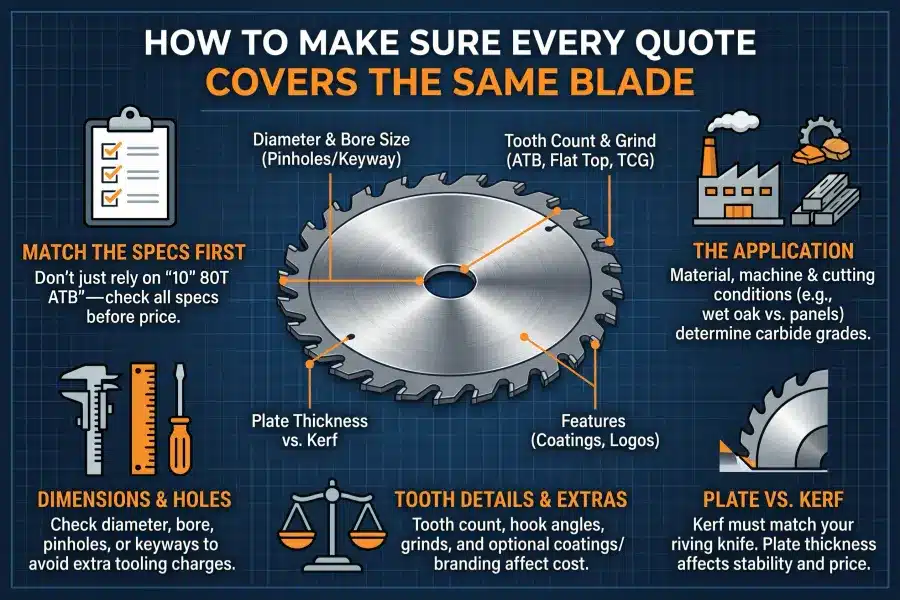
A simple listing like 10″ 80T ATB can actually refer to a dozen different blades. It leaves out many details a factory needs to build the blade, so check the specifications before comparing prices.
The application is the ultimate deciding factor. Make sure every vendor quotes for the same material, machine, and cutting conditions. Cutting wet oak for an entire shift generates more heat than cutting panels once or twice a week. Even with identical size and tooth count, these blades may need different carbide grades and plate thicknesses, resulting in different prices.
Next, check the diameter and bore size. If there is a pinhole or keyway, include that too, as non-standard holes may involve extra tooling charges.
Plate thickness and kerf are not the same thing, although quotes may only show one. A thinner plate uses less steel and requires less grinding, lowering the price, but it may flex more at higher feed rates. Kerf must also fit your riving knife, so a cheaper blade with a narrower kerf may not be safe to run.
The number of teeth matters when comparing blades of the same diameter. Larger diameter blades typically have more teeth, adding to brazing and grinding costs. Different tooth grinds, such as ATB, Flat Top, or TCG, and different hook angles also affect the price, as the teeth must suit the application.
Once these specs match, compare optional features such as logos, coatings, and packaging. Some suppliers charge extra for branding. If a supplier suggests an alternative specification, ask for separate quotes for both options so you can compare them directly.
Ask About the Specs the Quote Doesn’t Show
Quotes can be identical on everything that’s listed on the paper and still represent completely different blades. You won’t see many quotes that state what carbide they are using. Factors such as tip size, braze, plate, and tensioning all play a big role in why you may be getting a cheaper quote than another.
Tip size is particularly important because it dictates how many resharpenings are possible. If your supplier offers larger tips, you can sharpen your blade more and therefore get a lower cost over the blade lifespan. So, always have your supplier list these specifications on their quote or guarantee that their production blades will be similar to your sample.
The hypothetical check below follows three suppliers through this step.
| Specification | Supplier A | Supplier B | Supplier C |
| Application and duty | Match | Match | Match |
| Diameter and arbor | Match | Match | Pinholes not stated |
| Body thickness | Match | Thinner than requested | Match |
| Kerf | Match | Thinner than requested | Match |
| Teeth and geometry | Match | Match | Alternative grind offered |
| Customization | Logo and color box included | Color box charged separately | Match |
| Carbide, brazing and plate | Stated in writing | Not stated | Matches approved sample |
Supplier B’s lower price already has a likely explanation. A tighter TCT saw blade RFQ closes many of these gaps on your next round.
How Do Quantity and Commercial Terms Change the Real Price?
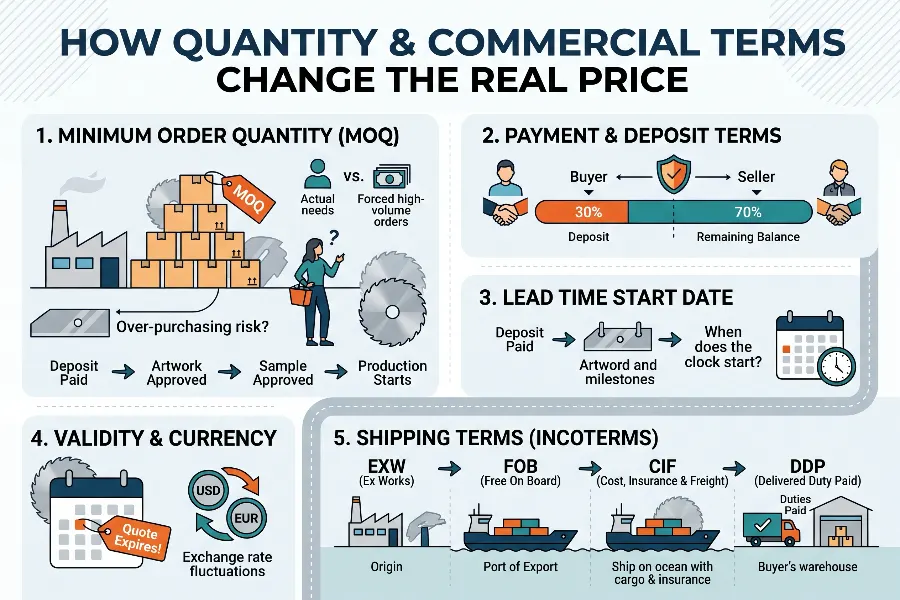
Several factors can affect the final cost of your blades. The first is the minimum order quantity (MOQ), which is the smallest number of units or minimum dollar amount a supplier will accept. If the MOQ is higher than your needs, you may end up paying for blades that sit in storage for months. Always compare quotes against the quantity you actually need.
Next, look at the payment terms. How much does the supplier require before production begins? Paying everything upfront puts more risk on your side, so compare each supplier’s deposit and remaining balance.
You should also confirm when the quoted lead time starts. Is it counted from deposit payment, artwork approval, or sample approval? These milestones can be weeks apart.
Check the quote’s validity date, too. Once it expires, the supplier may revise the price. Record the currency and convert all quotes using the same exchange rate on the same day.
Finally, check the shipping terms, or Incoterms, to understand where the supplier’s price ends. Common terms include:
- EXW: The price covers the goods at the seller’s facility.
- FOB: The supplier delivers the blades to the port of export.
- CIF: The price includes ocean freight and insurance to the destination port.
- DDP: The price includes delivery and customs duties to the agreed destination.
Make sure all quotes cover delivery to the same destination before comparing their prices.
Which Costs Might a Quotation Include or Leave Out?
There are many places where quotes can fall short between the supplier and your warehouse. Identify those points and add up all costs associated with getting the product to your location. Make sure your quotes have those costs and know who is responsible for them.
Packaging can get lost as well. Some will offer a simple box with your logo, and some may include full-color boxes with UPC barcode labels. Sample pricing can also fluctuate. Some are free, some you will pay for, and some will be deducted from your first order. Be sure to include sample freight in your quote.
If your product requires tooling (pin holes or different tooth shape), break down the cost based on how many units you plan on ordering. Also, ask whether this cost is applicable to future orders. You will then need to factor in inland freight to port, export fees, ocean freight, insurance, customs duties, taxes, and bank fees.
When calculating these costs into your quote, make sure you don’t double-count. For example, if your quote is CIF (Cost, Insurance, and Freight), the ocean freight is already included. So, don’t calculate ocean freight again. If your quote is DDP (Delivered Duty Paid), it already has customs duties factored in. If you receive sample credit on your first order, you don’t need to calculate that into the order. Don’t forget about packaging if it’s included in your price per unit.
What Does a Quotation Comparison Table Look Like?
Now that specifications and costs are finalized, we can compare each supplier’s cost per blade for the planned order quantity. Add the unit price, packaging, and tooling costs, then divide by the order quantity. Finally, add freight and import costs. The table applies this calculation to the same three suppliers. All figures are hypothetical and do not represent actual supplier prices.
Hypothetical Quotation Comparison for a Planned Order of 1,000 Blades
| Line item | Supplier A | Supplier B | Supplier C |
| Shipping term | FOB | EXW | DDP |
| Unit price | 10.00 | 9.20 | 12.40 |
| Color box packaging | Included | +0.50 per blade | Included |
| Tooling for custom arbor | 300 total (0.30 per blade) | Not stated | Included |
| Sample charge | 60, credited to first order | Not stated | Free |
| Inland transport and export clearance | Included in FOB | Buyer estimate 0.30 | Included |
| Freight and insurance | Buyer estimate 0.90 | Buyer estimate 0.90 | Included |
| Import duty and clearance | Buyer estimate 0.80 | Buyer estimate 0.80 | Included |
| Delivered cost per blade | 12.00 | 11.70 + tooling TBC | 12.40 |
| MOQ | 500 | 1,000 | 2,000 |
| Payment terms | 30% deposit, 70% before shipment | 100% in advance | 30% deposit, 70% before shipment |
| Lead time starts from | Deposit and artwork approval | Not stated | Sample approval |
| Quote valid for | 30 days | 15 days | 60 days |
| Designed for resharpening | Yes | Not stated | Yes |
Supplier B has the lowest price, but their offer is incomplete, and the plate thickness is below our requirement. Once tooling costs and the missing details are confirmed, this could become a competitive offer or fall out of consideration.
Supplier C appears most expensive, but the price includes freight and import costs. The main drawback is an MOQ twice our planned order quantity. This could still work if we can sell the additional blades.
Supplier A currently offers the best overall fit and meets our requirements. We still need to evaluate the samples when they arrive. For exact duty rates, double-check the figures with your customs broker.
How Should You Ask Suppliers to Fill the Gaps?
When you send out a list of questions to all of your suppliers, they can address any gaps more quickly. By using a list of structured questions, you have an even playing field. Tie the list to your RFQ revision and ask for a revised quotation. A revised document holds a supplier to their word, instead of just having informal conversations without documentation of any changes.
Here are some aspects to look for on a quote that may lead to questions. These aren’t ironclad rules, but they’re solid questions to ask.
What a Quote Shows and What to Ask Next
| What you see on the quote | What to ask |
| Price well below the others | Plate thickness, kerf, carbide grade and tip size, in writing |
| Unit price with no Incoterm | The named delivery point and every cost beyond it |
| Custom bore with tooling not stated | The tooling charge and whether it covers repeat orders |
| Lead time with no start event | Which event starts the clock |
| Spec that differs from your drawing | Whether it’s a typing error or a deliberate change |
| No drawing or itemized costs | Both, before the quote goes any further |
Price will only tell you so much. It may be affordable due to the light steel, smaller tip, or lack of a scope. Also, a higher price might be because of additional tests or features included. The most important factor is cost per cut, and regrinds, downtime, and rejected parts come into play.
The way the blade feels is proof of quality. Testing of the samples from the saw blades, under the specific cutting conditions, will tell you how they’ll perform. Furthermore, checking the manufacturer is a good way of seeing if this is the case. Lastly, the shipment inspection ensures you have what you ordered.
Conclusion
The bottom number on the page was never a stand-alone answer. Once the specifications are aligned and every dollar has a home, that number will often change. Sometimes the lead changes ownership completely.
Make sure the visible and invisible specs are agreed upon first, then align terms and delivery point. Put every cost in one place, construct the table, and close every gap in writing. Then let sample and inspection define quality, because price was never going to do that alone.
If your project requires a custom diameter, bore, tooth count, or packaging, forward your blade specification. We’ll evaluate them and craft a quote built for this exact comparison.
FAQs
Never share actual numbers or documents with another supplier. It almost always weakens your negotiation position. If you show a supplier a competitor’s price, they may match it and not add any additional benefits or improvements. However, if you tell a supplier that your quote is above your other choices, that should generally warrant a better price.
Both are valid. If you break the cost of the tooling down by the number of blades you are buying, then you will see the unit cost. If you take a look at the tooling as a one-off, you will see how much money may be lost if orders suddenly dry up after the initial run.
Yes, it’s possible to divide the order, but check what is being paid for. MOQ and custom tooling are different for each supplier. So, costs can be incurred from both. Also, there can be variations between blades manufactured from different factories. Therefore, at all times, approve samples from all suppliers before combining them in inventory.
A certificate is a statement of compliance that specifies the compliance of a given product or process against specified requirements. Also, check that the blade and its application are included in the certificate. Afterward, check its performance on your samples.