Finding a brush cutter blade is one thing. Finding one that actually fits your brush cutter is a whole different ball game.
You open your browser and suddenly you have to choose between 8-inch, 9-inch, and 10-inch blades. Then there is the bore size, tooth pattern, maximum RPM, mounting hardware, and a dozen other specifications that seem to leave you with more questions. Which numbers matter? Can you simply use the biggest blade that fits?
Relax. You do not need to learn these things the hard way. This article explains what brush cutter blade size means, which specifications determine compatibility, and how to choose a blade that suits both your machine and the job.
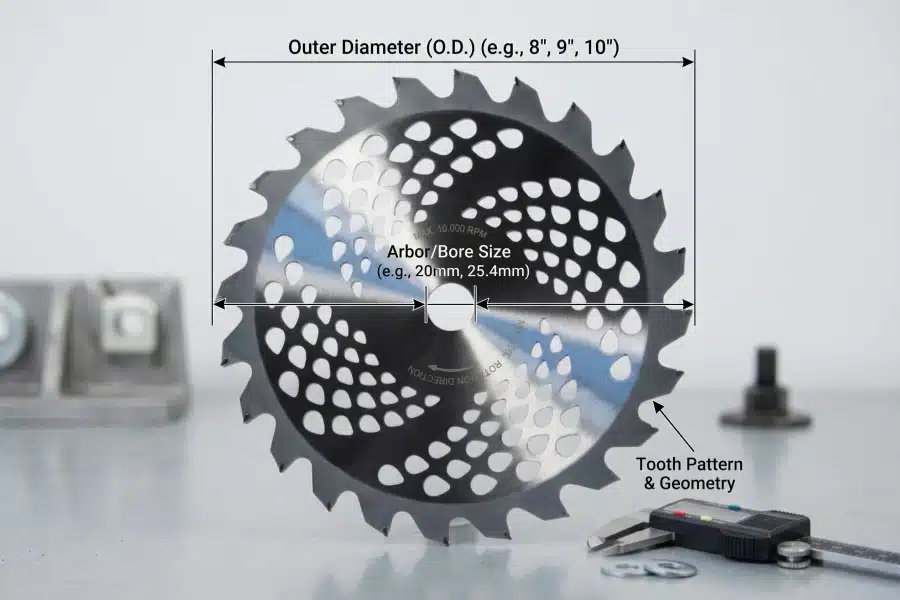
Table of Contents
- What Does Brush Cutter Blade Size Mean?
- How to Determine What Size Brush Cutter Blade You Need
- Can an Adapter or Reducing Washer Solve a Bore-Size Difference?
- Brush Cutter Blade Size Checklist Before Buying
- What If the Blade Doesn’t Match Your Requirements?
- Conclusion
- FAQs About Brush Cutter Blade Sizes
What Does Brush Cutter Blade Size Mean?
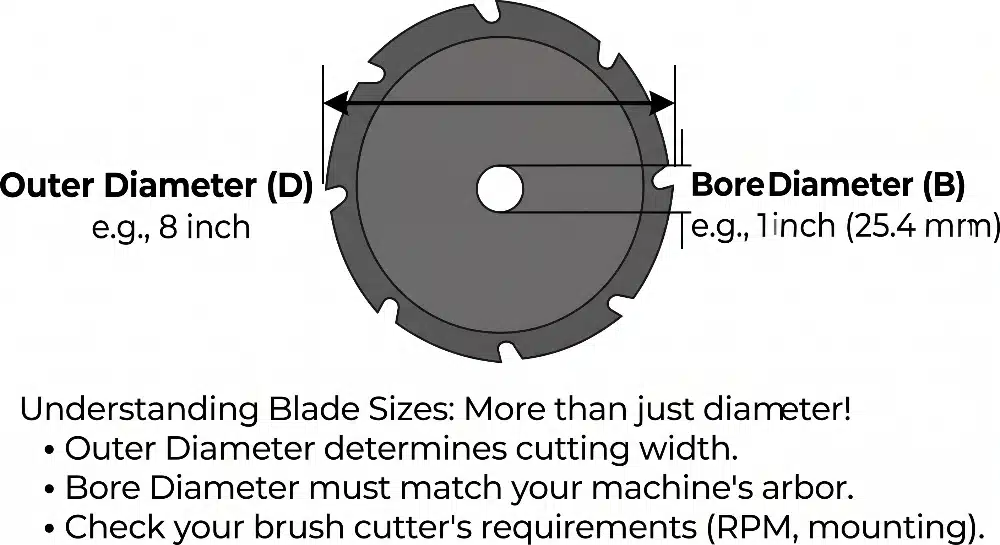
Brush cutter blade size usually refers to the blade’s diameter, such as 8, 9, or 10 inches. However, diameter alone does not tell you whether a blade will fit or work safely on your brush cutter. You must also check the bore, mounting system, maximum RPM, and the attachment requirements specified by the machine manufacturer.
Diameter is the distance across the blade. It is usually the first measurement you will notice on the packaging or product page, but it is only one part of the selection process.
The bore is the hole in the center of the blade. Common brush cutter blade bore sizes include 20 mm and 25.4 mm (1 inch). The bore must suit the arbor or approved mounting hardware that holds the cutting attachment in place.
Maximum RPM, or revolutions per minute, tells you the highest rotational speed for which the blade is rated. You may also see specifications such as blade thickness, tooth count, blade type, weight, and included mounting hardware.
In short, diameter tells you how large the blade is. The other specifications help determine whether that blade is compatible with your brush cutter and intended application.
How to Determine What Size Brush Cutter Blade You Need
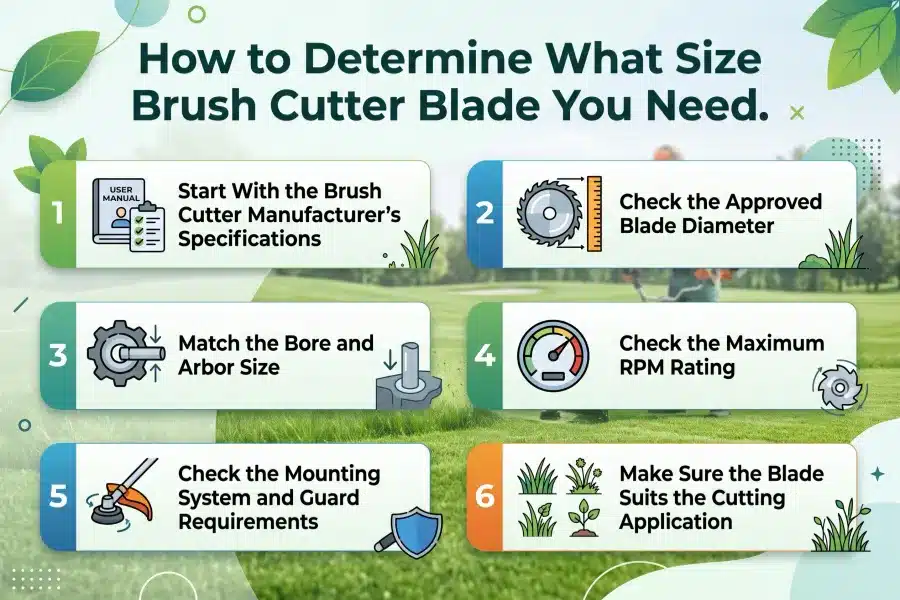
To determine the correct brush cutter blade size, start with the manufacturer’s specifications and then check the approved diameter, bore size, maximum RPM, mounting system, guard, and attachment type. A blade should meet the complete set of requirements rather than matching only one or two measurements.
Start With the Brush Cutter Manufacturer’s Specifications
The brush cutter manufacturer’s specifications should be your starting point because they identify the blade sizes and cutting attachments intended for that particular machine.
The first place to look is not the blade shelf. It is your brush cutter’s user manual.
Find the exact brand and model, then check which cutting attachments the manufacturer approves. Two brush cutters with similar engine sizes may not accept the same blade. The gearbox, clutch, shaft, mounting hardware, guard, and other machine components can all affect which blade configurations the tool was designed to use.
You do not need to memorize every technical term before shopping. First, identify the specifications required by your particular brush cutter. Once you know what the machine can handle, narrowing down your blade options becomes much easier.
Check the Approved Blade Diameter
Choose a blade diameter that falls within the size or range approved for your brush cutter. Common brush cutter blade diameters include approximately 8 inches (200 mm), 9 inches (225–230 mm), and 10 inches (250–255 mm), although exact measurements can vary between manufacturers.
The diameter determines the width of the cutting sweep, so a larger blade can cover a wider area. That does not necessarily make it the better option.
A larger blade also places more demand on the machine. It needs enough clearance inside the guard and attachment assembly, and the brush cutter must be designed to support that blade size.
Do not automatically gravitate toward a 10-inch blade just because it offers a wider cut. Start with the diameter approved for your machine. Once you have confirmed that measurement, move on to the center hole and mounting arrangement.
Match the Bore and Arbor Size
The blade bore must match the arbor or approved mounting hardware on the brush cutter. A blade can have the correct outer diameter and still be impossible to install because its center hole does not suit the machine.
Bore sizes of 20 mm and 25.4 mm (1 inch) are common, but they are not universal. A manufacturer may offer an otherwise similar brush cutter blade in several diameter-and-bore combinations. That is why you should check the listed measurements instead of guessing from the way a blade looks.
The arbor is the part of the mounting system that locates and secures the blade. If you are unfamiliar with this measurement, our guide to saw blade arbor sizes explains how arbor holes and reducing rings work.
Matching the bore confirms only one part of the fit. It does not guarantee that the blade diameter, speed rating, guard, and complete mounting arrangement are compatible with the brush cutter.
Check the Maximum RPM Rating
The blade’s maximum RPM rating must be high enough for the rotational speed at which the brush cutter drives that attachment. Never use a blade at a speed above the maximum RPM marked or specified for the blade.
It is possible for a blade to have the right diameter and bore but still have an unsuitable speed rating. This is easy to overlook because a blade can appear to fit perfectly while the machine is switched off.
Check the brush cutter manual or the manufacturer’s attachment specifications for the relevant output or attachment speed. Do not rely only on the engine RPM, because engine speed and cutting-attachment speed are not necessarily the same. Compare the correct machine specification with the blade’s maximum RPM and follow any additional manufacturer instructions.
Diameter and bore help determine whether the blade can be mounted. The RPM rating helps determine whether it can operate within its rated speed limit.
Check the Mounting System and Guard Requirements
The blade must work with the brush cutter’s complete approved mounting system and guard arrangement. Matching the diameter and bore is not enough if the blade requires different hardware, clearance, or protective equipment.
Check the shaft configuration, blade holder, fastening hardware, guard or deflector, and any other parts specified for the cutting attachment. Some machines require a particular guard or conversion kit before they can be used with a metal blade.
The type of attachment also matters. A brush cutter may permit certain grass knives, brush blades, or circular saw-style blades without approving every blade that happens to fit the shaft.
Treat the blade and its mounting components as one complete configuration. If you are unsure whether the parts are permitted together, check the manual or ask the brush cutter manufacturer.
Make Sure the Blade Suits the Cutting Application
The blade must be designed for the material you plan to cut. Size and mounting compatibility tell you whether a blade suits the machine, while blade type, tooth pattern, and construction help determine whether it suits the job.
A blade intended for grass and light weeds may not be the right option for dense brush or woody saplings. Likewise, a saw-style blade designed for woody growth may be unnecessary for routine grass clearing.
Check the blade manufacturer’s stated application after confirming machine compatibility. Do not select a blade by tooth count or appearance alone.
Can an Adapter or Reducing Washer Solve a Bore-Size Difference?
A reducing washer or adapter may solve a bore-size difference only when the blade and brush cutter manufacturers approve that specific mounting arrangement. It can compensate for a larger center hole, but it cannot make an otherwise incompatible blade suitable for the machine.
If a blade’s bore is larger than the approved mounting diameter, an authorized reducing washer may allow the blade to locate correctly on the arbor. However, the washer does not change the blade’s outer diameter, maximum RPM, thickness, guard requirements, or intended attachment type.
The blade itself must still be suitable for the complete brush cutter setup. A reducing washer addresses one measurement. It does not change the machine’s other specifications.
Never substitute improvised washers, spacers, or homemade mounting parts for an approved configuration.
Brush Cutter Blade Size Checklist Before Buying
Before buying a brush cutter blade, confirm the full set of machine, blade, and mounting specifications. The checklist below helps prevent a blade with the right diameter but the wrong bore, speed rating, or attachment configuration from ending up in your cart.
| Specification | What to check | Why it matters |
|---|---|---|
| Manufacturer approval | User manual or official documentation | Confirms the permitted setup |
| Blade diameter | Approved diameter or range | Ensures proper size and clearance |
| Bore size | Blade center-hole measurement | Fits the approved arbor |
| Arbor and mounting | Shaft and required hardware | Secures the blade correctly |
| Maximum RPM | Blade rating versus attachment speed | Prevents overspeed |
| Guard or deflector | Required guard and clearance | Provides protection and clearance |
| Attachment type | Approved blade or knife type | Matches the machine |
| Cutting application | Material the blade is designed for | Matches the job |
Do not base your decision on a single row. The blade needs to meet all applicable requirements for the machine and setup.
What If the Blade Doesn’t Match Your Requirements?
If a brush cutter blade does not match your machine’s requirements, do not force it to fit. Find a blade with the correct diameter, bore, RPM rating, mounting configuration, guard requirements, and approved attachment type.
A slight bore difference may be manageable when the manufacturer allows an approved reducing washer or adapter for that exact blade and machine. Even then, the adapter only addresses the center-hole difference. It does not make an oversized blade or an incompatible attachment safe.
If standard blades do not provide the combination of diameter, bore size, thickness, or tooth design you require, you can also consider a custom brush cutter blade. The custom specifications must still remain compatible with the intended machine, mounting system, operating speed, and application.
Conclusion
The right brush cutter blade is one that matches the complete set of requirements for your machine and cutting application. A larger blade is not automatically better, and a blade that fits over the arbor is not automatically compatible.
Start with the brush cutter manufacturer’s documentation. Check the approved diameter, bore and arbor arrangement, maximum RPM, mounting hardware, guard, and attachment type. Then make sure the blade is intended for the material you plan to cut.
That may sound like a long list, but it takes the guesswork out of buying a blade—and it is much easier than learning through trial and error.
FAQs About Brush Cutter Blade Sizes
Dimensions are usually listed as diameter × bore × thickness. For example, 255 × 25.4 × 1.6 mm means a 255 mm diameter, 25.4 mm bore, and 1.6 mm thickness.
Yes. Blade thickness can affect mounting, clearance, weight, and machine load, so it should match the approved specification.
Only when the measurements are truly equivalent. For example, 25.4 mm equals 1 inch, but 200 mm does not exactly equal 8 inches.
Search for the exact model number on the manufacturer’s official website or contact an authorized service provider. Do not choose a blade based only on appearance.
Yes. Tooth count, tooth shape, material, weight, and intended application can produce different cutting results even when the dimensions match.