Some aspects of blade specifications are pretty straightforward. Diameter tells you the blade size, and tooth count gives you a good idea of the finish it can produce. But what about hook angle? It’s one of those specifications that often goes unnoticed, yet it has a major impact on cutting speed, control, and cut quality. As a result, it’s often misunderstood or simply overlooked when choosing a saw blade.
The good news is that hook angle isn’t nearly as complicated as it sounds. By the end of this article, you’ll understand what hook angle is, how it affects cutting performance, and how to choose the right hook angle for different materials and projects.
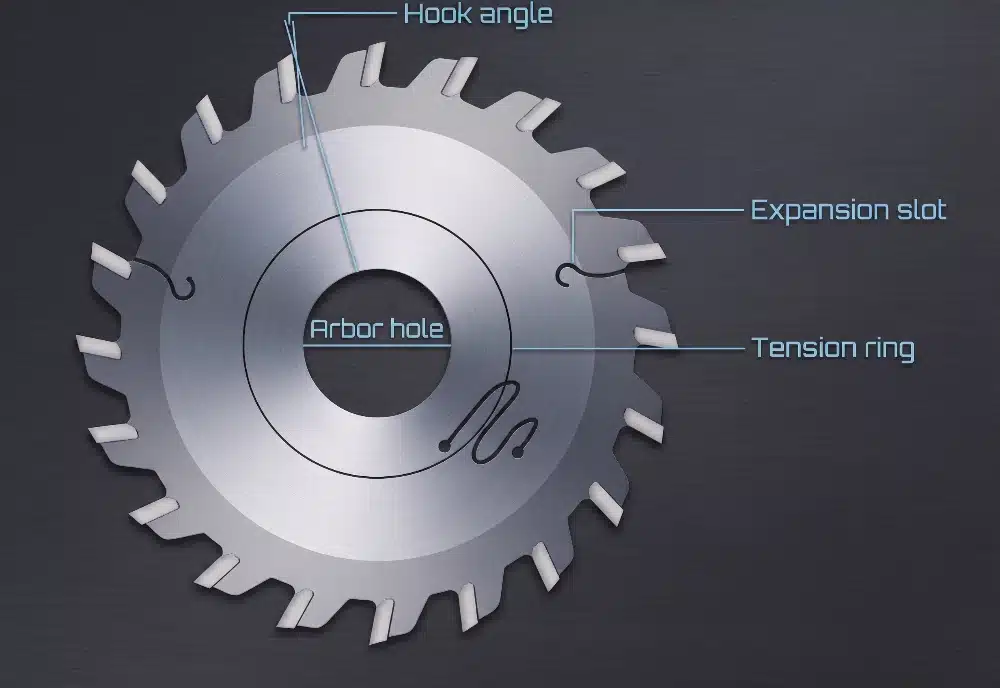
Table of Contents
- What Is Hook Angle on a Circular Saw Blade?
- How Does Hook Angle Affect Feed Rate?
- Will a Higher Hook Angle Make My Blade More Aggressive?
- How Does Hook Angle Affect Cut Quality?
- Does Hook Angle Affect Kickback?
- What Hook Angle Is Best for Different Materials?
- How Do You Choose the Right Hook Angle for Your Project?
- Conclusion
- FAQs About Hook Angle
What Is Hook Angle on a Circular Saw Blade?
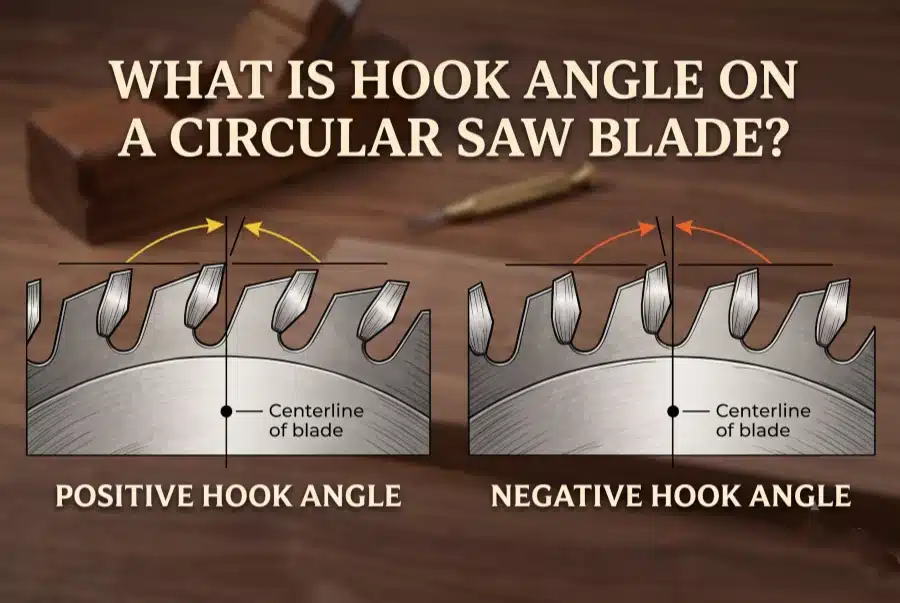
Hook angle is the angle of a circular saw blade’s teeth. It is measured relative to an imaginary vertical line running from the center of the blade to the tip of each tooth. It affects how the blade enters the material, influencing cutting speed, control, and cut quality.
Hook angle does not determine what materials a blade can cut, but it does affect how efficiently and smoothly the blade cuts different materials. Even a small change in hook angle can make a blade feel faster, smoother, or easier to control. That’s why two blades with the same diameter and tooth count can perform very differently.
There are three common hook angle types: positive, zero, and negative.
| Hook Angle | Tooth Direction | Common Applications | Main Benefit |
|---|---|---|---|
| Positive | Teeth lean forward | Ripping solid wood, framing lumber | Faster, more aggressive cutting |
| Zero | Teeth are neutral | General-purpose cutting | Balanced cutting performance |
| Negative | Teeth lean backward | Plywood, laminates, plastics, and non-ferrous metals | Better control and reduced grabbing |
A positive hook angle allows the blade to feed into the material more aggressively, making it ideal for fast cutting. A zero hook angle provides balanced cutting performance for general-purpose applications. A negative hook angle slows the feed rate and offers greater control, making it a common choice for plywood, laminates, plastics, and non-ferrous metals because it helps reduce grabbing.
How Does Hook Angle Affect Feed Rate?
Hook angle affects feed rate by changing how quickly a blade moves through the material. A higher positive hook angle increases feed rate, while a lower or negative hook angle slows the cut for greater control.
A blade with a higher positive hook angle pulls through the material more easily, allowing you to maintain a faster feed rate with less effort. This makes it well suited for ripping softwood, framing lumber, and other applications where productivity matters more than surface finish.
Blades with a low or negative hook angle remove material more gradually, resulting in a slower feed rate. While cutting takes longer, the slower pace gives you better control over the workpiece. This makes them a good choice for cutting crown molding, plywood, cabinet panels, and other projects where accuracy is more important than speed. Think about ripping a board of framing lumber versus cutting a cabinet part. One rewards speed, while the other rewards patience and finesse.
Will a Higher Hook Angle Make My Blade More Aggressive?
Yes. A higher positive hook angle makes a blade cut more aggressively because the teeth engage the material earlier and take a larger bite with each pass.
As the teeth lean farther forward, they pull the blade into the cut more readily. This self-feeding action reduces the amount of force needed to keep the cut moving and helps clear chips efficiently during long rip cuts.
That extra bite is a major advantage for framing, rough-sizing lumber, and other production work where cutting speed is the priority. However, more aggressive isn’t always better. Delicate materials, precision cuts, and fine woodworking usually benefit from a smaller hook angle that provides a smoother, more controlled cutting action.
How Does Hook Angle Affect Cut Quality?
Hook angle affects cut quality by changing how the teeth enter and exit the material. A higher positive hook angle removes material quickly, while a lower or negative hook angle produces cleaner, smoother edges.
A high positive hook angle cuts aggressively and maintains strong forward cutting action. However, it can also lift wood fibers as the teeth exit the cut, increasing the likelihood of splintering or chipped edges on fragile materials.
Lower hook angles engage the material more gradually, allowing the teeth to shear wood fibers more cleanly. The result is smoother edges with less tear-out. That’s why many woodworkers choose lower or negative hook angles for plywood, veneered panels, melamine, and decorative moldings. Cleaner cuts also mean less sanding and touch-up before assembly.
Does Hook Angle Affect Kickback?
Hook angle does not directly cause kickback, but it can influence how aggressively a blade feeds into the material. Kickback is primarily caused by blade binding or improper cutting technique.
A higher positive hook angle naturally encourages the blade to pull itself into the cut. This self-feeding action can make the saw feel more responsive, especially during rip cuts. For experienced users, that often improves efficiency. For beginners, however, it can feel like the saw wants to move forward faster than expected.
Because the blade feeds more aggressively, maintaining proper control becomes more important. If the blade binds in the cut, the risk of kickback increases regardless of hook angle. Many premium saw blades include anti-kickback design features that help limit overly aggressive feeding, but safe cutting still depends on proper blade selection, workpiece support, and correct operating technique.
What Hook Angle Is Best for Different Materials?
The best hook angle depends on the material you’re cutting. There is no single hook angle that’s ideal for every application.
Softwoods are generally best cut with a positive hook angle because it provides faster cutting. Harder, more brittle materials often benefit from a lower or negative hook angle, which offers greater control and helps reduce chipping or grabbing.
The table below summarizes the recommended hook angles for some of the most common materials. Use it as a general guide when selecting a saw blade.
| Material | Recommended Hook Angle | Main Benefit |
|---|---|---|
| Softwood | Positive | Faster cutting |
| Hardwood | Moderate positive | Better balance of speed and finish |
| Plywood | Low positive | Cleaner edges |
| MDF | Low positive or neutral | Reduced tear-out |
| Laminate | Negative | Less chipping |
| Plastic | Negative | Reduced grabbing |
| Aluminum | Negative | Improved control |
How Do You Choose the Right Hook Angle for Your Project?
The right hook angle depends on both the material you’re cutting and the result you want to achieve.
Start with the material, as it’s usually the quickest way to narrow your options. Softwoods generally perform best with a higher positive hook angle because they allow faster, more aggressive cutting. Plywood, MDF, laminates, plastics, and aluminum often benefit from a lower or negative hook angle, which provides better control and helps reduce tear-out or chipping.
Next, consider your cutting priority. If speed and material removal are your main goals, choose a higher positive hook angle. If you’re focused on clean edges, fine finishes, or maximum control, a lower or negative hook angle is usually the better choice.
Use the comparison table below to choose the right hook angle for your project.
| Choose a Higher Positive Hook Angle When… | Choose a Lower or Negative Hook Angle When… |
|---|---|
| Making fast rip cuts in solid wood | Cutting plywood, MDF, laminates, or aluminum |
| Removing large amounts of material | Creating clean edges and fine finishes |
| Doing framing or rough construction work | Maximum control during the cut is important |
Conclusion
Choosing the right hook angle is less about memorizing angles and more about matching the blade to the material and the job.
Don’t try to memorize every hook angle. Just know when a more aggressive blade works in your favor and when a lower hook angle offers better control. A blade that rockets through framing lumber might be totally wrong for plywood or aluminum, and that’s perfectly normal.
Every hook angle is a trade-off between cutting speed, control, and finish quality. Once you understand those trade-offs, blade labels become much easier to understand. Instead of guessing, you’ll know why one blade feels right for the job while another doesn’t.
FAQs About Hook Angle
A positive hook angle means the blade’s teeth lean forward. This allows the blade to feed into the material more aggressively, making it ideal for ripping solid wood and other applications where faster cutting is the priority.
A negative hook angle means the teeth lean backward. It slows the blade’s feeding action, providing better control and helping reduce grabbing, chipping, and tear-out when cutting plywood, laminates, plastics, and non-ferrous metals.
A low positive or negative hook angle is usually the best choice for plywood. These hook angles help reduce splintering and tear-out, resulting in cleaner edges and a better finish.
A moderate positive or zero hook angle is often the best choice for general-purpose cutting. It provides a good balance of cutting speed, control, and cut quality for a wide range of woodworking tasks.
Yes. A higher positive hook angle generally increases cutting speed by allowing the blade to feed more aggressively into the material. Lower or negative hook angles cut more slowly but offer better control and cleaner results on delicate materials.